No one in that house expected me to come back for Christmas. I certainly didn’t expect to be thrown onto the floor like a stray dog the moment I walked through the door. Nine months of deployment, nine months of sand and sweat and shrapnel, and I came home to a metal folding chair shoved into the corner near a drafty heating vent. The snow was thick and blinding as I drove through Ohio, my knuckles white against the steering wheel.
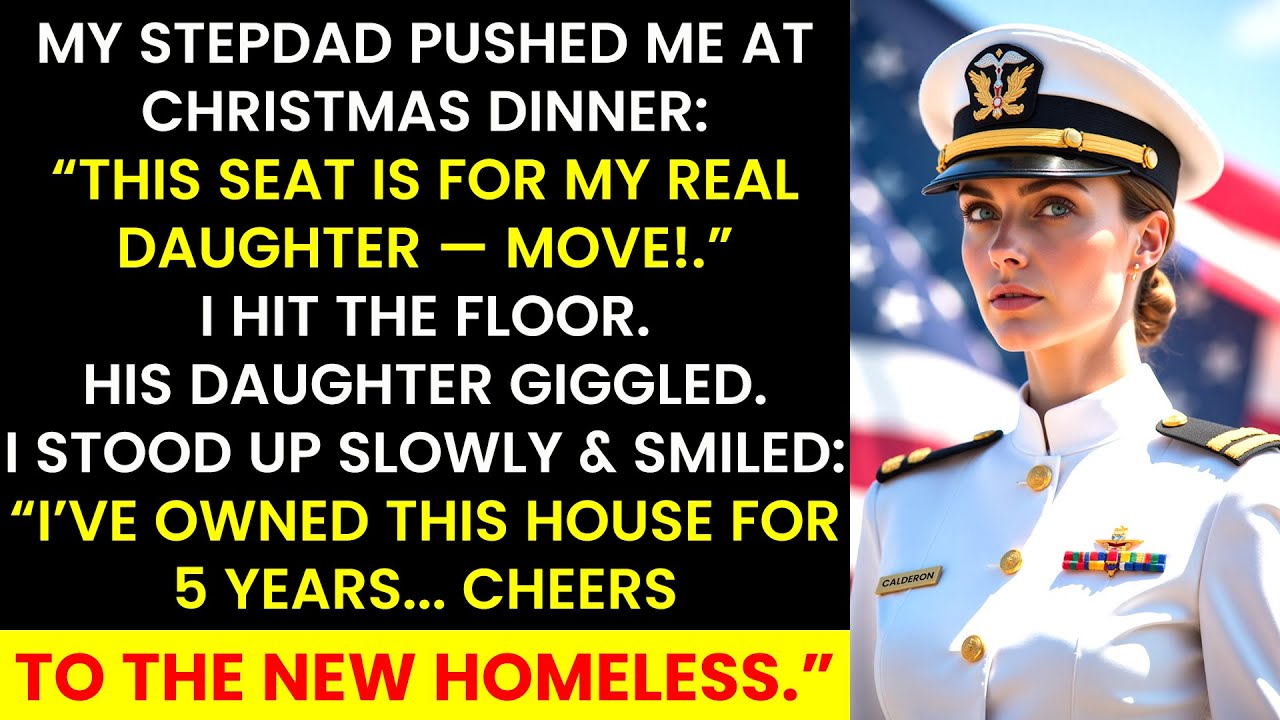
I had bought a bottle of Woodford Reserve, sixty dollars I didn’t really have to spare, as a peace offering for Richard. I thought maybe, just maybe, I could buy a ceasefire for the holidays. I thought the uniform would earn me a shred of respect, or at least a seat at the table like a human being. I was wrong.
The living room smelled like pine needles and stale cigarette smoke. Richard sat in his recliner, a can of Bud Light in his hand, his eyes glued to the football game. He didn’t look up when I walked in. Emily, my twenty-two-year-old stepsister, was sprawled across the sofa, her face glowing blue from her phone.
She glanced at my service dress blues and sneered. “Are you still wearing that costume? ” she asked. “It’s Christmas, Livia.
Nobody cares. ”
My mother, Sarah, stayed in the kitchen. She wiped her hands on her apron and looked everywhere except at me. That’s when I realized it.
I wasn’t a daughter returning from service. I was an intruder breaching their perimeter. The dining room table was set like a scene from a magazine. Candles flickered.
The bone china my grandmother left behind gleamed under the soft light. There were three plush red velvet chairs arranged around the turkey. The fourth spot, the one where I should have sat, was missing. In its place, shoved into the corner, was a rusted metal folding chair.
On the table in front of it sat a flimsy white paper plate. “What is this? ” I asked, my voice steady even though my pulse was hammering. Richard chuckled, a wet, hacking sound.
“House is full, Olivia. Besides,” he took a long swig of his cheap beer, “you’re used to eating tray rations in the mess hall. You should feel right at home in the corner. ”
I refused to accept it.
I walked to the head of the table, the spot Richard claimed as his throne. I reached for the heavy wooden chair, intending to pull it out and sit down like a person. “I will not sit in the corner,” I said firmly. Richard moved faster than I thought a man his size could.
He launched himself from the recliner like a bear poked with a stick, his face turning a deep, violent red. “Do not give orders in my house! ” he roared. His thick, calloused hand slammed into my chest.
It wasn’t a shove. It was a strike. My boots skidded on the slippery rug and I went down hard. My right shoulder, the one that took shrapnel in a firefight, hit the unforgiving oak floor.
I felt something pop, a sickening sound that echoed in my ears, and the old injury flared into white-hot agony. I lay there gasping for air, staring up at the ceiling I had paid to fix last summer. Through the ringing in my ears, I heard Emily giggling. “Oh my god,” she laughed, holding up her phone to capture my misery.
“You fell so dramatically. It’s like a B-movie stunt. ”
I could have gotten up and broken Richard’s arm. The Navy had trained me well.
I knew exactly how to dismantle a man of his size in under three seconds. But then the voice of Jocko Willink echoed in my mind, clearer than the pain. *Discipline equals freedom. Detach.
Do not let emotion dictate action. *
I did not scream. I did not cry. Slowly, painfully, I pushed myself up and dusted off my uniform.
Richard stood over me, chest heaving, waiting for the outburst. He wanted me to be the crazy veteran. He wanted a reason to call the cops. Instead, I reached into my bag and pulled out the sixty-dollar bourbon.
I cracked the seal, the sound loud in the sudden silence. I poured a glass and looked Richard dead in the eye. “Cheers, Richard,” I said, my voice ice cold. “Merry Christmas, and congratulations to the newly homeless.
”
I downed the drink, the burn of the alcohol matching the fire in my gut. I slammed the glass down on the table, turned my back on them, and walked out into the blizzard. I sat in my Jeep, parked on the shoulder of the snowy road a few blocks from the house. The engine idled, the heater blasting against my frozen hands, but the chill deep in my bones had nothing to do with the Ohio winter.
My right shoulder throbbed with a dull, rhythmic ache. As I rubbed the tender joint, my mind drifted back through the years, reopening the cold case file of how I ended up here, shivering in a car while a tyrant feasted at my table. I was seventeen when my biological father died. He was a good man, quiet and hardworking, the kind who saved every penny in a coffee can.
He left behind a life insurance policy worth fifty thousand dollars. It was supposed to be a safety net for my mother and me, a chance for college, a chance for security. Richard entered the picture two months after the funeral. He came with a slick smile and a promise that tasted like ash.
“I’ll take care of you and the girl, Sarah,” he had told my mother, placing a heavy hand on her shoulder. But taking care apparently meant feeding his own ego. Within six months, that fifty thousand dollars had evaporated. It didn’t go into a savings account.
It went into a brand-new Ford F-150, lifted, with expensive rims and a sound system that shook the windows. The rest disappeared into a black hole of failed sports bets and scratch-off lottery tickets. I remember the night I turned eighteen. I came home from my shift at the diner to find my mother crying at the kitchen table.
The landlord was threatening eviction. Richard was out at the bar showing off his truck. That was the moment the girl died and the soldier was born. I didn’t join the Navy because I loved war.
I joined because I needed the signing bonus to pay off their back rent. Three years later, I had earned something Richard never could: the credit and the right to buy a home. I used the VA loan, the sacred privilege of the American veteran, zero down payment backed by the government, earned through sweat and sand in foreign deserts. I remember sitting in the title company’s office, my hands still calloused from basic training, signing a mountain of paperwork.
I was twenty-one, and I was buying a beautiful ranch-style house in the suburbs. But before the ink was dry, my mother grabbed my hand, her eyes rimmed with red. “Livia, please,” she had whispered. “Don’t tell Richard the house is in your name.
You know how he is. He has such high pride. If he knows he’s living under his stepdaughter’s roof, it will destroy him. He’ll leave us.
”
Because I loved her, and because I was young and stupid enough to believe that peace could be bought with a lie, I agreed. “Okay, Mom,” I said. “We’ll say we did it together. ”
That was the tactical error that doomed me.
For the last five years, an automatic allotment has been deducted from my military paycheck every single month to cover the mortgage, the property taxes, and the insurance. I paid for the new roof. I paid for the furnace repair. I paid for the very floorboards Richard had just thrown me onto.
But inside those walls, Richard played the role of the lord of the manor. He mounted a stuffed deer head on the living room wall without asking me, drilling holes into the drywall I paid for. When I came home on leave last year and tried to hang a small Navy flag in my old bedroom, he tore it down. “It ruins the aesthetic of my house,” he had sneered.
“Keep that military garbage on the base. ”
I heard stories from the neighbors. They told me how Richard held court at the local VFW, bragging about the empire he had built for his family. He accepted their pats on the back, drinking beers bought with the money he saved by not paying rent.
He was living a lie, and my silence was the foundation that held it up. I looked into the rearview mirror. The bruise on my shoulder was already darkening, spreading like ink under my skin. I had spent my life following the commandment, “Honor thy father and mother.
” I thought honoring them meant enabling them. I thought taking the high road meant letting them walk all over me. But tonight, as I watched the snow pile up on my windshield, I realized I hadn’t been protecting my mother. I’d been financing her abuse by letting Richard believe he was the king.
I had given him the power to treat me like a peasant. The silence ended tonight. I reached into my pocket and pulled out my phone. My hands were steady now.
The shaking had stopped. I scrolled through my contacts until I found the name I needed: Marcus, attorney at law. I hit the dial button. It rang twice before he picked up, his voice gruff but warm.
“Livia. Merry Christmas. Everything okay? ”
“No, Marcus,” I said, my voice flat and hard.
“I need a favor. I need you to go to your office vault on Christmas Eve. ”
“What for? ”
“I need the deed, Marcus.
The original deed to the house, and I need a draft for an eviction notice. ”
There was a pause, followed by the sound of a chair scraping back. “It’s about damn time,” Marcus said. “I’ll meet you in the morning.
”
I hung up and looked back toward the house, its windows glowing with a warm, deceptive light. They were probably eating the turkey now, laughing at the homeless girl. Enjoy the meal, Richard. It will be your last one at my table.
To understand why a stepfather would shove a wounded veteran on Christmas Eve, you have to understand that the violence didn’t start with a push. It started with a thousand tiny cuts inflicted over the three days leading up to the holiday. I arrived home seventy-two hours before the dinner. I walked down the hallway toward my old bedroom, the one place in this house I still considered my sanctuary.
It was where I kept my seabag, my books, and the few memories of my biological father that I had managed to save from Richard’s pawn shop purges. I opened the door, expecting the smell of old books and lavender. Instead, I was hit by a blinding explosion of neon pink and the chemical stench of cheap hairspray. My bed had been shoved into the corner, piled high with clothes that still had tags on them.
In the center of the room stood a massive ring light and a tripod aimed like a weapon at a full-length mirror. My desk was buried under an avalanche of drugstore makeup, half-empty Starbucks cups, and tangled charging cables. But what stopped my heart was what I saw on the floor. My service dress blue’s jacket.
The uniform I had worn to my promotion ceremony. The uniform I kept crisp and lint-free as a matter of honor, balled up on the carpet. Emily was using it as a mat to stand on so her bare feet wouldn’t touch the cold floor while she filmed her dance video. “What are you doing?
” I asked, my voice barely a whisper. Emily paused her recording and popped her gum. “Oh, you’re back early,” she said, not moving off my jacket. “I just needed the lighting.
This room has the best morning sun for my aesthetic. You can sleep on the sofa, right? I mean, you’re used to sleeping in the dirt in the woods or whatever. ”
I walked past her, ignoring the urge to tip over her tripod, and went to the bookshelf in the corner.
I was looking for the shadow box containing my Navy commendation medals and the folded triangular flag from my father’s funeral. The shelf was empty. Panic, cold and sharp, spiked in my chest. I fell to my knees and started tearing through the room.
I found them under the bed, shoved into a cardboard box that smelled of mold, sitting right next to a pile of Emily’s muddy sneakers. The glass on the shadow box was cracked. “Why did you touch these? ” I growled, clutching the box to my chest.
My mother appeared in the doorway, wiping her hands on a dish towel. “Now, Olivia, don’t be dramatic,” she pleaded. “Emily needed creative space. Those medals, they look a little violent.
They were throwing off the positive vibes of her live stream background. We just packed them away for safekeeping. ”
I looked at my mother. My sacrifice and my father’s memory were throwing off the vibes of a twenty-two-year-old’s lip-sync video.
The next morning, I tried to reclaim some normalcy. I went to the kitchen to make pancakes using the flour and eggs I had bought with my own money the night before. Richard lumbered into the kitchen, scratching his stomach. He watched me whisk the batter, his eyes narrowing as they focused on my arms.
“Look at you,” he scoffed, grabbing a piece of bacon off the plate I had just set down. “You’ve got arms like a brick layer. No wonder you’re still single. Men want a woman, Livia, not a GI Jane who looks like she could bench press a Buick.
”
He laughed at his own joke, crumbs springing onto the table. “You planning on staying in the service forever, or is it just that the boys on base are the only ones desperate enough to look at you? ”
He ate the breakfast I cooked while dismantling my womanhood between bites. It was a specific kind of cruelty designed to make me feel small in the only body I had.
If you have ever had a family member belittle your appearance or your hard-earned achievements just to make themselves feel bigger, you know exactly how much it burns. It is a silent poison. The breaking point came on the afternoon of Christmas Eve, just hours before the dinner. I was in the garage checking the oil in my Jeep, trying to escape the suffocating atmosphere of the house.
Richard cornered me there. He closed the garage door, blocking out the light. “I heard the military creates big tax-free bonuses for reenlistment,” he said, leaning against his truck. His voice had lost its mocking tone.
Now it was just greedy. “I need $5,000, Livia. ”
“For what? ” I asked, not looking up from the dipstick.
“The roof,” he lied smoothly. “It’s got a leak. Needs fixing before the heavy snow sets in. ”
I froze.
I had paid for a complete roof replacement last year. I knew exactly what he wanted. I had seen the brochures for the new Polaris snowmobile on the kitchen counter. He wanted a new toy to show off to his drinking buddies.
“No,” I said, wiping my hands on a rag. “The roof is fine, Richard. I have the warranty paperwork. ”
His face transformed.
The mask of the friendly stepfather slipped, revealing the predator underneath. He stepped close, invading my personal space, smelling of tobacco and aggression. “You’ve been eating my food and using my heat for three days,” he hissed. “You think you can just come here, wave your money around, and not help the man who raised you?
You’re ungrateful. You’re stingy. ”
He looked at me with pure disgust, then gathered spit in his mouth and spat on the concrete inches from my combat boots. “Cheap,” he muttered, turning to walk away.
That spit was a declaration of war. When he pushed me later that night, it wasn’t an accident. It was the punishment for saying no. I drove away from the house with the engine roaring, putting as much distance between myself and Richard as the icy roads would allow.
I didn’t have a destination in mind until I saw the flickering neon sign of The Outpost cutting through the swirling snow. It was a run-down dive bar attached to the local VFW post, a place where time stood still and the outside world ceased to matter. The wind howled like a banshee as I stepped out of the Jeep, the cold air biting at my exposed face. But the moment I pushed open the heavy wooden door, the atmosphere shifted.
The air inside was thick and warm, smelling of stale beer, lemon floor cleaner, and the faint ghostly scent of tobacco smoke that had seeped into the walls decades ago. Creedence Clearwater Revival played low on the jukebox, a familiar rhythm that felt like a heartbeat. I scanned the room. It was sparsely populated, mostly by older men in ball caps embroidered with the names of forgotten ships and distant wars.
They sat hunched over their drinks, respecting the silence of the holiday. I took a seat at the far end of the bar, keeping my back to the wall, a habit I had never been able to break since my first tour. “Jack Daniels. Neat,” I told the bartender.
I rested my right arm on the sticky wood of the counter, wincing as a sharp bolt of pain shot from my shoulder up to my neck. I wanted to rub it, to massage the knot forming around the old shrapnel wound, but I forced my hand to stay still. In here, you didn’t show weakness. You didn’t advertise your pain.
Suddenly, a heavy hand landed gently on my left shoulder. “Livia? ” A deep voice rumbled. “Is that Hawkeye from Bravo Company?
”
I turned, my hand instinctively moving toward a defensive posture before I recognized the face. It was Marcus. He had traded his Kevlar vest for a flannel shirt and a blazer, but the eyes were the same. Sharp, observant, the eyes of a man who had scanned rooftops for snipers in Fallujah.
He was a jagged scar of a man, rough around the edges, but he was the best JAG lawyer the Marine Corps had ever produced before he retired to private practice. “Marcus,” I breathed, feeling the tension in my chest loosen just a fraction. He slid onto the stool next to me, signaling the bartender for two more rounds, but he didn’t smile. His eyes narrowed as he looked at me, scanning my posture with clinical precision.
“You’re listing to the right,” he said, pointing a finger at my shoulder. “You’re guarding that side. Your trap muscle is in a spasm. What happened?
You reinjure the old war wound? ”
I stared at him, a bitter laugh escaping my throat. My mother had lived in the same house with me for three days. She had watched me cook, clean, and eat, and she had not noticed a thing.
Marcus had looked at me for three seconds and knew exactly where I was hurt. “It’s a long story, Marcus,” I said, taking a sip of the whiskey. “I’ve got nowhere to be,” he replied. “Talk.
”
So, I did. I told him everything. I told him about the folding chair in the corner next to the trash can. I told him about the bone china I wasn’t allowed to use.
I told him about Richard’s demand for $5,000. The spit on the garage floor. And finally, the shove that sent me sprawling onto the hardwood. Marcus listened in silence, his jaw tightening until a muscle feathered in his cheek.
When I finished, he slammed his beer bottle down on the bar. Foam hissed over the rim. “He shoved you? ” Marcus growled, his voice low but vibrating with a dangerous frequency.
“That old parasite dared to put his hands on you in the house you bought for him? ”
His anger wasn’t pity. It was righteous indignation. It was the protective fury of a big brother who just found out his sister was being bullied on the playground.
Except the playground was a mortgage and the bully was a fifty-eight-year-old narcissist. For the first time all night, the cold sensation of being invisible evaporated. I was seen. I was valued.
“I could have him in handcuffs by midnight,” Marcus said, reaching for his phone. “Assault and battery, domestic violence. With your medical history, that’s a felony charge, Livia. ”
I shook my head.
“No police. If I have him arrested, my mother gets dragged into it. She’ll have to testify. She’ll fall apart.
Marcus, I can’t do that to her. ”
Marcus sighed, rubbing his temples. He knew me too well. He knew I would take a bullet before I let collateral damage hit the people I loved, even if those people were enabling my misery.
“Fine,” Marcus said, a shark-like grin slowly spreading across his face. “We don’t use the police. We use the nuclear option. Do you remember where the original deed is?
”
“In the vault at your office,” I replied. “Exactly,” he said. “And do you have the bank statements showing five years of mortgage payments deducted from your military allotment? ”
“Saved on my phone.
”
Marcus nodded, the lawyer in him taking over the soldier. “Tomorrow morning is December 26th. I’ll go into the office early. I’m going to pull your file.
I’ll draft a formal eviction notice effective immediately based on a breach of unwritten lease terms regarding tenant conduct. I’ll print out every single bank transfer you have ever made. ”
He leaned in closer, his voice dropping to a conspiratorial whisper. “I’m going to hand you a paper cannon, Livia.
All you have to do is walk in there, place it on the table, and pull the trigger. ”
The image of Richard’s face when he realized the game was over flashed in my mind. It was the first thing that had made me smile in days. “You’d do that on a holiday?
” I asked. “For you? ” Marcus said. “In a heartbeat.
” He reached out and covered my hand with his, his palm rough, warm, and steady. “Listen to me, Hawkeye. You don’t owe them anything. Blood is not a get-out-of-jail-free card for being a terrible human being.
They broke the contract of family a long time ago. You’re just finalizing the paperwork. ”
His words hit me harder than the whiskey. I had spent so long trying to buy their love with silence and money.
I thought sacrifice was my duty. Marcus reminded me that duty ends where abuse begins. “Thank you, Marcus,” I said. “Prepare the file.
Tomorrow, I’m taking back what is mine. ”
I finished my drink and stood up. My shoulder still throbbed, but the pain felt different now. It was no longer the ache of a victim.
It was the battle scar of a survivor. I walked out of The Outpost and back into the blizzard. The wind was still screaming, but I didn’t shiver. I had a plan.
I had a weapon. And most importantly, I knew I was right. I checked into a Motel 6 just off the interstate. The kind of place where the neon sign buzzes loud enough to hear through the thin glass, and the parking lot is filled with long-haul truckers and people who have nowhere else to go on Christmas Eve.
The room smelled of industrial-strength bleach and despair. The carpet was sticky and the heater rattled like it was dying, but it was warm, and more importantly, it was mine. I paid for it with cash. No one could kick me out.
No one could tell me where to sit. I locked the deadbolt and threw my bag on the bed. Slowly, methodically, I began to strip off my uniform. I hung the jacket with care.
Old habits die hard. But when I peeled off my undershirt and stood before the bathroom mirror, the soldier vanished, leaving only a battered woman. The lighting in the bathroom was harsh and fluorescent, unforgiving in its honesty. I turned my shoulder toward the glass.
The bruise had bloomed. What had been a red mark an hour ago was now a deep, violent shade of purple and black, spreading across my deltoid and down toward my chest like a storm cloud. I touched it gently with my fingertips. A sharp bolt of pain shot through my nerve endings, stealing the breath from my lungs.
This was not a nightmare. This was not a misunderstanding. This was physics. Richard, a man who lived off my paycheck, who ate the food I bought, had put his hands on me with the intent to harm.
He had marked his territory on my skin. I reached for my phone, but not to call anyone. I opened the camera and snapped three photos of the injury from different angles. I wasn’t going to post them on social media for sympathy like Emily would.
I was documenting evidence. This was the first step in admitting that my kindness had been a fatal strategic error. Then the phone buzzed in my hand. A text message.
My heart hammered against my ribs. A tiny, foolish part of me hoped it was an apology. I hoped it was my mother saying she had packed her bags, that she was leaving him, that she chose me. I looked at the screen.
*Mom: Livia, please come back. Dad is not mad anymore. He says if you come in and apologize for your attitude earlier, he will let you sleep on the sofa tonight. It’s Christmas.
Don’t be stubborn. *
I stared at the words, reading them over and over until they blurred. She didn’t ask if I was hurt. She didn’t ask where I was sleeping in a blizzard.
She didn’t ask if my shoulder, the one she knew was reconstructed with titanium pins, was okay. Her only concern was managing Richard’s mood. She was negotiating the terms of my surrender. Apologize.
Apologize for being shoved. Apologize for being humiliated. Apologize for existing in a space I paid for. Something inside me, something soft and daughter-like that I had been protecting for years, finally died.
I realized then that my mother was not a hostage in that house. She was a collaborator. She had seen the violence and she had chosen to protect the aggressor because it was easier than facing the truth. She was an enabler, and in that moment, she was just as dangerous to me as Richard.
I did not reply. Instead, I closed the messaging app and opened my banking application. I logged in and scrolled down to the recurring transfers. There it was, scheduled to go out in five days.
Mortgage payment. $1,200 for five years. Every time I saw that number leave my account, I felt a swell of pride. I thought I was building a nest egg.
I thought I was being a good daughter. But looking at it now, under the hum of the motel neon light, it looked like extortion. It looked like protection money paid to a mobster who beat you up anyway. My thumb hovered over the transaction.
*Manage autopay. Cancel recurring payment. * A warning box popped up on the screen. *Are you sure you want to cancel this payment?
Late fees may apply. *
I pressed yes with so much force I thought I might crack the screen. Autopay cancelled. A shiver ran down my spine, but it wasn’t from the cold.
It was the physical sensation of a heavy chain snapping. I had just cut the fuel line to Richard’s ego. Without my money, without my silence, the facade of his life would crumble within thirty days. I wasn’t just stopping a payment.
I was taking back my power. I turned off the lights and lay on the stiff mattress, staring at the ceiling shadows. The wind howled outside, sounding like the ghosts of my past trying to get in. My mind started to race.
Guilt, fear, anger, a chaotic whirlwind threatening to pull me under. I reached for my phone one last time and put in my earbuds. I navigated to my podcast library and selected Jocko Willink. I needed a voice that didn’t offer pity.
I needed a commanding officer. *Discipline equals freedom. Don’t let your emotions control you. Detach.
Step back. Look at the situation from above. Assess. Plan.
Execute. *
I closed my eyes and breathed in rhythm with the voice. Detach. I pushed the image of my mother’s weeping face out of my mind.
That was an emotional distraction. Assess. I was the legal owner of the property at 420 4th Street. The occupants were hostile squatters who had violated the verbal lease agreement through physical assault.
Plan. I had the deed. I had the eviction notice Marcus was printing. I had the financial records.
I was no longer the sad girl crying in a motel room. I was Sergeant Calderan. And I was preparing for urban combat. Objective: Secure the perimeter and reclaim the base.
Hostiles: one adult male, volatile. Civilians: two adult females, compromised and manipulated. Hour: 0800 hours tomorrow. Weapon: The absolute undeniable truth.
I pulled the scratchy blanket up to my chin. I didn’t cry. I didn’t dream. I slept the deep, dreamless sleep of a soldier the night before the invasion.
Tomorrow was going to be a long day. At 7:00 in the morning, the alarm on my phone vibrated against the cheap laminate nightstand. I didn’t hit snooze. I was already awake, staring at the ceiling, breathing in a four-count rhythm.
In, two, three, four. Hold, two, three, four. Out. I rolled out of bed and stepped directly into a freezing cold shower.
The shock of the icy water hit my skin like a slap, washing away the grogginess of the motel sleep and sharpening my senses. I needed my nervous system to be firing on all cylinders. When I stepped out, I did not reach for my comfortable jeans or the oversized sweater I usually wore to hide my body. I reached for the garment bag I’d hung on the back of the bathroom door.
I unzipped it slowly. Inside was my service dress blues. This was not just clothing. It was a symbol.
It was six buttons of gold, a black neckerchief, and rows of colorful ribbons that told the story of where I had been and what I had survived. I pulled the trousers on, the wool fabric stiff and familiar. Then came the jumper. I tightened the neckerchief, feeling the fabric constrict slightly against my throat.
It was a sensation that usually made me feel confined, but today it felt like a neck brace holding my head high. I fastened the gold buttons one by one. Click, click, click. Each one felt like I was locking a piece of armor into place.
I pinned my ribbons to my chest, checking their alignment in the mirror with obsessive precision. Finally, I placed the white Dixie cup hat on my head, tilting it to the regulation angle. The woman staring back at me in the motel mirror was not Livia, the stepdaughter who apologized for taking up space. She was a sergeant in the United States Navy.
She was a woman who had directed convoy movements in hostile territory. She was dangerous. I checked out of the motel at 7:30 and drove straight to Marcus’ office. The town was quiet, the streets empty in the post-Christmas lull.
Marcus was waiting for me at the door, a steaming cup of black coffee in one hand and a thick manila envelope in the other. He looked tired, but his eyes were alert. “Here is the package,” he said, handing me the envelope. It was heavy.
Inside was the certified copy of the deed, five years of bank statements highlighting every single mortgage transfer, and a formal eviction notice signed and notarized. “This is the nuclear option, Livia,” Marcus said, watching my face closely. “Once you put this on the table, you can’t take it back. It will burn everything to the ground.
”
I took the envelope, feeling the weight of the paper. It felt heavier than the M4 carbine I used to carry. “They struck the match last night, Marcus,” I said, my voice steady. “I’m just controlling the burn.
”
I climbed back into my Jeep and turned the key. The engine roared to life, a mechanical beast ready for a fight. I drove toward the house, my heart beating a slow, heavy drum against my ribs. The snow had stopped falling, leaving the sky a bruised iron gray.
As I turned onto my street, I saw it. The house looked peaceful under a blanket of white, but the driveway told a different story. Richard’s massive lifted Ford F-150 was parked diagonally across the driveway, blocking the entrance completely. It was his signature move, a territorial pissing contest he played every time I came home.
Usually, I would sigh, park on the street, and walk up the icy path to avoid upsetting him. Not today. I didn’t slow down. I shifted my Jeep into four-wheel drive and swerved off the pavement.
My tires bit into the front lawn, tearing through the pristine layer of snow and churning up the frozen earth beneath. I drove right past his truck, leaving deep, muddy ruts in the grass he was so proud of, and pulled up inches from the front porch. I cut the engine. The sudden silence was deafening.
I stepped out of the car. My polished black boots hit the concrete walkway with a loud, authoritative clack, clack, clack. The front door swung open. Richard stepped out wearing a stained bathrobe and clutching a snow shovel.
A cigarette dangled from his lip. He looked ready to scream about his lawn, but when he saw me, the words died in his throat. He blinked, taking in the uniform, the ribbons, the hat. For a second, he looked unsure.
But then his narcissism kicked back in. “Well, look at this,” he sneered, leaning on the shovel like a sentry guarding his post. “The general has returned. What’s with the costume?
You think playing dress-up is going to scare me into letting you back in for breakfast? ”
He stepped forward, using his large frame to block the doorway. He loomed over me, trying to cast a shadow, trying to make me feel small. It was the same intimidation tactic he had used since I was seventeen.
If you have ever had to stand your ground against a bully who thought they were bigger and stronger than you, you know how fast your heart beats in this moment. I didn’t flinch. I didn’t look down. I looked him dead in the eye, my gaze colder than the winter air.
“Step aside, Richard,” I said. “Or what? ” he challenged, smirking. “You going to cry again?
Go back to your car. You’re not eating my food. ”
I took a step forward, invading his space, forcing him to shift his weight back. “I’m not here to eat,” I said, clutching the manila envelope tight.
“I’m here to take out the trash. ”
I dipped my shoulder and brushed past him, my dress uniform scraping against his stained bathrobe. He was too stunned by my audacity to stop me. I walked down the hallway, the rhythmic strike of my heels on the hardwood echoing like a countdown clock.
I entered the dining room. The domestic scene before me was almost comical in its normalcy. My mother and Emily were seated at the table picking at a breakfast of scrambled eggs and burnt toast. The smell of cheap margarine and coffee hung heavy in the air.
When my mother saw me, her hands spasmed. Her fork clattered onto her ceramic plate, the sharp noise slicing through the silence. “Livia,” she stammered, her face draining of color. Her eyes darted frantically over my shoulder, looking for Richard, looking for the storm she knew was coming.
“You… you came back. ”
Emily didn’t even look up from her phone. She was propped up on one elbow, scrolling through comments on her live stream. “If you’re here to apologize, make it quick,” Emily mumbled, popping a piece of toast into her mouth.
“I’m live right now, and I really don’t need your negative energy ruining my engagement metrics. ”
I didn’t answer. I didn’t even look at her. Instead, I began to circle the table.
I moved slowly, deliberately, like a shark patrolling the perimeter of a reef before the strike. I walked behind my mother, feeling her shrink away from me. I walked behind Emily, pausing for a second to glance at the ring light reflecting in her vacant eyes. I walked past the empty folding chair in the corner, the metal cage they had tried to put me in, and kicked it aside.
It fell with a loud metallic crash. Emily jumped. My mother flinched. Then Richard stormed into the room.
He looked like a mad bull, his face a mottled map of red rage. He marched toward the table, slamming his hand down so hard that the coffee cups danced in their saucers. Brown liquid sloshed over the rim of his mug, staining the tablecloth. “Are you deaf, girl?
” he roared, his voice shaking the walls. “I told you to get on your knees and apologize. You don’t walk into my house dressed like a clown and ignore me. ”
The room fell into a terrified silence.
In the past, this was the moment I would have crumbled. I would have looked at my shoes, mumbled an apology, and begged for peace. But the Livia who begged was dead. I reached up and slowly removed my white Dixie cup hat.
With deliberate care, I placed it on the table right next to the platter of bacon. In Navy culture, placing your cover on the domestic table is a breach of etiquette. But here, it was a flag planting. I was claiming this territory.
Then I turned to the head of the table, Richard’s seat. It was a heavy oak chair with armrests, the only one of its kind at the table. It was his throne. It was where he sat to dispense his judgments and insults.
I grabbed the back of the chair. I dragged it out. The wooden legs screeched against the floor, a sound like a scream. I sat down.
I settled into the cushion, rested my elbows on the armrests, and laced my fingers together. I looked up at Richard. The reaction was immediate and visceral. My mother gasped, covering her mouth with both hands.
Emily finally lowered her phone, her mouth hanging open, realizing that something unprecedented was happening. And Richard… Richard looked like his brain had short-circuited. “You…” he sputtered, a vein in his forehead pulsing dangerously. “You dare sit in my chair, in my house?
”
He took a menacing step toward me, raising his hand. It was the same motion he had used the night before. He intended to strike me again. He wanted to slap the insolence out of my face.
I didn’t flinch. I didn’t blink. I didn’t move a muscle. I just watched him with the cold, dead eyes of a predator who knows the prey has already lost.
My right hand moved slowly to the manila envelope I had placed on the table. I tapped it once with my index finger. Tap. “Sit down, Richard,” I said.
My voice was not loud, but it was hard as granite. “Standing is tiring for a man of your age. ”
He froze. The sheer unnatural calmness of my demeanor stopped him.
Bullies operate on fear. They need the flinch, the tear, the plea for mercy to fuel their power. When they don’t get it, their system crashes. He lowered his hand, uncertainty creeping into his eyes for the first time.
“I have a late Christmas gift for you,” I continued, sliding the thick brown envelope across the polished wood. It stopped right in front of his plate, resting next to the coffee stain. “I think you’ll appreciate this more than the bourbon I bought yesterday. ”
Richard stared at the envelope, his eyes narrowed, suspicion warring with greed.
I could see the gears turning in his head. He saw the thickness of the package. He remembered the rumor about my reenlistment bonus. He thought it was cash.
He thought I had withdrawn $5,000 to buy his forgiveness and save my place in the family. “What is this? ” he grunted, his voice losing some of its edge. “You think you can buy me off?
You think money fixes respect? ”
“Open it,” I commanded. “But be careful. The contents might be a little hard to swallow on an empty stomach.
”
Greed won. It always does with men like him. He snatched the envelope from the table. “This better be good,” he muttered.
He ripped the top of the envelope open with violent, jerky movements. He reached inside and pulled out the stack of documents. The first thing that fell out wasn’t a stack of $100 bills. It was a sheaf of legal paper, heavy and white, stamped with the red official seal of the county clerk.
The papers hit the table with a dull thud. My mother leaned forward, squinting to see. Emily craned her neck. I leaned back in the head chair, crossing my arms over my chest, a small, icy smile playing on my lips.
The fuse was lit. The explosion was inevitable. “Read it, Richard,” I whispered. “Read it out loud.
”
Richard held the document in his thick, trembling hands, his eyes squinting as if trying to decipher a foreign language. But the words were in plain English, bold and undeniable against the stark white paper. *Deed of trust. Sole owner, Livia Calderan.
Date of purchase, May 15th, 2018. *
The color drained from his face, turning from a rage-filled red to a sickly ash gray pallor. His hands, usually so steady when holding a beer or a remote control, began to shake violently. The paper slipped from his grip, fluttering through the air like a wounded bird before landing softly on the hardwood floor between us.
“What? What the hell is this? ” he stammered. His voice, usually a booming thunderclap that shook the walls, was now thin and reedy.
It was the voice of a man realizing the ground beneath him had turned to quicksand. “Read it out loud, Richard,” I commanded. My voice was ice, devoid of any warmth. “Let the whole family hear who actually owns the roof over their heads.
”
He opened his mouth, but no sound came out. He looked at the paper on the floor as if it were radioactive. Emily, unable to contain her curiosity, snatched the paper up. She scanned it, her eyes widening in genuine shock.
She looked at me, then at Richard, then back at the paper. “It says she owns it,” Emily read aloud, her voice trembling. “It says, ‘Sole owner, Livia Calderan. ’ Dad, is this real?
”
The room plunged into absolute suffocating silence. It was the sound of a five-year-old lie shattering into a million pieces. My mother covered her face with her hands and let out a single sharp sob. The truth was out, naked and ugly.
The man who called himself the king of the castle was nothing more than a squatter living on the charity of the daughter he had just tried to kick out. “No, that’s impossible! ” Richard suddenly yelled, the denial erupting from him like bile. “You… you tricked me.
This is my house. I pay the bills. ”
He looked around wildly, desperate to salvage his crumbling ego. “I pay the electric bill!
” he shouted, pointing a shaking finger at the ceiling light. “I fixed the leaky faucet in the bathroom. I bought the fertilizer for the lawn. This is my home!
”
I stood up slowly from the head chair. I didn’t yell. I didn’t need to. I had the numbers.
“You pay the electric bill? ” I asked, my tone mocking. “That’s roughly $200 a month. Good for you, Richard.
”
I picked up the stack of bank statements Marcus had printed for me and slammed them onto the table. Whack. “I pay the mortgage,” I said, leaning over him. “That’s $1,200 every 30 days for five years.
I pay the property taxes. That’s $4,000 a year. I paid $5,000 for the new roof you bragged about to your friends. You are not the owner, Richard.
You are a tenant. And you are a terrible, ungrateful, violent tenant. ”
Every number I spoke was a physical blow. I watched him shrink.
The narrative he had built for himself, the provider, the patriarch, the success story, was dissolving. He wasn’t a hero. He was a moocher. “Now,” I said, stepping around the table until I was standing right next to him.
“Let’s talk about last night. ”
Richard instinctively took a step back, bumping into the china cabinet. The plates rattled, a sound of fragility. For the first time in my life, I saw genuine fear in his eyes.
“You assaulted the property owner,” I stated, my voice dropping to a dangerous whisper. “Under Ohio state law, that’s domestic violence. I can call the police right now. I can show them the bruise on my shoulder.
I can show them the deed. ”
I pulled my phone from my pocket and held it up. My thumb hovered over the emergency call button. “I can get a restraining order, Richard.
The police will come here, put you in handcuffs, and drag you out to your truck in front of all the neighbors. You’ll lose your reputation. You’ll lose your freedom. You’ll be nothing more than a violent old man with an arrest record.
”
“No! ”
The scream didn’t come from Richard. It came from my mother. She threw herself out of her chair and rushed toward me, grabbing my arm.
Her face was wet with tears, her eyes wide with panic. “Don’t call the police,” she begged, clutching my sleeve. “Livia, please, don’t do this to him. It will kill him.
”
I looked down at her. For years, she had stood between us to protect him from my truth. Now, she was begging me for mercy. The power dynamic had shifted so completely it was almost dizzying.
She wasn’t defending his actions. She was pleading for his survival. I looked back at Richard. He was trembling like a leaf in a storm.
He knew I had him. He knew I could end his life as he knew it with one tap of my thumb. I lowered the phone slowly. “I will not send you to jail today,” I said.
“But the game is over. The rules have changed. ”
I pointed to the grandfather clock in the hallway. “You have exactly 60 minutes,” I declared.
“You can go upstairs, pack your bags, and get out of my house forever. ”
Richard opened his mouth to protest, but I cut him off with a sharp gesture. “Or,” I continued, pointing to the corner of the room, “you can go pick up that metal folding chair, the one you made me sit in last night, and bring it back here. If you want to stay under my roof, you will sit in that chair and you will listen to my conditions.
The choice is yours, Richard. The clock is ticking. ”
Richard looked at the door, then at me, and finally at the rusted metal chair lying on the floor where I had kicked it. The arrogance was gone.
The king was dead. He swallowed hard, his Adam’s apple bobbing in his throat. Then, without a word, he turned his back on the door. He walked slowly, his shoulders slumped in defeat, toward the folding chair.
He picked it up, his hands shaking, and carried it back to the table. He placed it down opposite me, and he sat. The 60-minute deadline I had given Richard came and went, but the front door never opened. The sound of a suitcase zipper never zipped.
The truck engine never started. Instead, a strange, heavy silence descended over the house at 420 4th Street. It wasn’t the tense silence of a predator waiting to strike, but the hollow silence of a regime that had toppled. Richard spent the entire morning and afternoon sitting on that rusted metal folding chair.
He stared at the wall, motionless, like a statue carved from regret and cheap tobacco. My mother and Emily had retreated to their bedrooms, hiding behind closed doors, too terrified to witness the fallout of the patriarch’s collapse. By the time the grandfather clock in the hall chimed 1 in the morning, the house was dark, save for the single lamp burning next to the sofa where I sat. I was reading a book, or at least pretending to.
My ears were tuned to the slightest sound. I heard the floorboards creak. Richard emerged from the shadows of the dining room. He looked smaller than he had this morning.
His shoulders, usually pulled back in a posture of aggressive dominance, were slumped forward. His bathrobe was disheveled, and his eyes were rimmed with red, sunken deep into his face. He walked toward the living room, his steps hesitant. He stopped a few feet away from me, his hands fidgeting with the frayed hem of his sleeve.
It was the nervous tick of a child called into the principal’s office. “Can I…? ” His voice cracked, dry. He cleared his throat and tried again.
“Can I speak with you? ”
I slowly closed my book and placed it on the coffee table. I didn’t invite him to sit on the plush leather recliner, his usual throne. I simply nodded.
Richard didn’t move toward the recliner. Instead, he pulled over a small, low ottoman and sat down. For the first time in twenty years, he was physically looking up at me. The power dynamic had been reestablished, not by force, but by the gravity of truth.
“Why do you hate me so much, Richard? ” I asked. The question hung in the air, stripped of anger, just raw curiosity. Richard looked down at his hands, his knuckles white.
His shoulders began to shake. “I don’t hate you, Livia,” he whispered, the words barely audible. “I… I am afraid of you. ”
I blinked, taken aback.
“Afraid of me? ”
He looked up, and I saw tears tracking through the stubble on his cheeks. “I grew up with nothing,” he confessed, his voice trembling. “My whole life, I tried to be the big man.
I tried to be the provider, the guy people respected. But I failed. Every business idea, every bet, every job, I messed it up. ”
He gestured vaguely toward my uniform jacket hanging on the coat rack.
“Then you came along. You joined the Navy. You got that uniform. You got the discipline.
You got the money to buy this house when you were just a kid. You became everything I wanted to be but never could. Every time I looked at you, I saw my own failure staring back at me. I saw proof that I wasn’t enough.
”
He took a ragged breath. “So I had to push you down. I had to make you feel small. Make you sit in the corner.
Make you feel like a guest, just so I could feel like the owner for five minutes. It wasn’t hate, Livia. It was envy. It was pathetic, weak, old man jealousy.
”
It was a confession so naked, so stripped of his usual bluster, that it sucked the oxygen out of the room. He wasn’t a monster under the bed. He was just a sad, broken man, terrified of his own mediocrity. I looked at him for a long moment.
Part of me, the part that remembered the spit on the garage floor, wanted to crush him. But the soldier in me knew that you don’t execute a surrendered enemy. You rehabilitate them, or you neutralize the threat. “Understanding your problem is the first step, Richard,” I said, my voice steady but firm.
“But understanding isn’t enough. You need action. ”
I reached into the pocket of my sweatpants and pulled out a single sheet of notebook paper. I had spent the last hour writing it out.
“This is the new lease agreement,” I said, handing it to him. “If you want to sleep under my roof tonight, if you want to stay married to my mother, you will agree to these terms. ”
Richard took the paper with shaking hands. He squinted in the dim light to read my handwriting.
“Number one,” I recited from memory. “You will attend Alcoholics Anonymous meetings three times a week. You will also enroll in anger management therapy at the VA center downtown. I want to see signed attendance slips every Sunday night.
”
He nodded slowly, not looking up. “Number two, financial transparency. You will no longer control the household funds alone. My mother’s name goes on a joint checking account with you tomorrow.
No more secret spending. No more gambling. ”
“And number three,” I said, my voice hardening to steel. “Zero tolerance policy.
You will never raise your voice, raise your hand, or insult me, my mother, or even Emily again. If you call me a name, if you push anyone, that eviction notice gets filed with the sheriff the same day. Do you understand? ”
Richard read the paper again.
He knew what this was. It wasn’t a punishment. It was a lifeline. I was offering him a chance to be the man he pretended to be rather than the fraud he was.
“I understand,” he said. “Do you agree? ”
“I agree. ”
He reached for the pen I offered.
His hand shook as he signed his name at the bottom of the page. The signature was messy, jagged, but it was there. He handed the paper back to me, then looked me in the eye. The arrogance was gone, replaced by a profound exhaustion.
“Thank you, Livia,” he said, his voice thick with emotion. “Thank you for not throwing a useless old man out into the snow. ”
“I didn’t do it for you, Richard,” I said, folding the paper and putting it back in my pocket. “I did it for my mother.
And I did it because this house deserves peace. ”
He nodded, stood up slowly, and shuffled toward the stairs. He looked ten years older than he had this morning. “Good night, Livia,” he murmured.
“Good night, Dad,” I said. It was the first time I had used the word without choking on it. It wasn’t a term of endearment yet. It was a rank I was allowing him to earn back.
I turned off the lamp and lay down on the sofa, pulling the blanket up to my chin. For the first time in five years, inside the house that I owned, I closed my eyes and fell into a deep, dreamless sleep. And for the first time, I didn’t lock the door. Three months had passed since the night of the eviction notice.
The brutal Ohio winter finally broke, retreating north to make way for a fragile, hopeful spring. The snow mounds that had lined the streets were gone, replaced by patches of green grass and the yellow heads of daffodils pushing up through the thawing earth around the old oak tree in the front yard. I pulled my Jeep into the driveway on Easter Sunday. The first thing I noticed was the order.
For years, Richard parked his massive Ford truck diagonally, blocking the path, a metal beast marking its territory. Today, it was parked perfectly parallel to the garage door, leaving ample space for me. It was a small detail, a geometric adjustment, but in the language of our household, it spoke volumes. It was a silent admission of respect.
I walked into the house, bracing myself out of habit for the smell of stale cigarette smoke. But the air was clear. It smelled of lemon polish and roasting meat. “Happy Easter, Liv.
”
Emily walked out of the kitchen. She wasn’t holding a ring light or staring at a screen. She was wearing a red polo shirt and khaki pants. Her uniform for her new job as a cashier at Target.
She looked tired. Her feet probably hurt from standing on concrete for an eight-hour shift, but her eyes were clearer than I had ever seen them. “I picked up a morning shift for the holiday pay,” she said, grinning. “Time and a half.
I’m saving for my own apartment. ”
My mother was at the dining table arranging a bouquet of tulips. She looked younger. The deep lines of worry that used to etch her forehead, the lines carved by walking on eggshells for twenty years, had softened.
“He’s in the kitchen,” she whispered to me, tilting her head. “Go say hello. ”
I walked into the kitchen. Richard was wearing an apron over his church clothes.
He was bent over the oven, basting a turkey. This was part of his therapy. Acts of service to replace acts of dominance. He scrubbed the floors now.
He cooked. He mowed the lawn without complaining. “Hello, Richard,” I said. He straightened up, wiping his hands on a dish towel.
He looked thinner. The bloat from the cheap beer was gone, replaced by a healthier, albeit more weathered, complexion. Sobriety suited him. “Livia,” he nodded, his voice quiet.
“Turkey needs 10 more minutes. Why don’t you go sit down? ”
We gathered in the dining room. The table was set with the same bone china from Christmas, but the atmosphere couldn’t have been more different.
The tension that used to suffocate this room was gone. And most importantly, there was no metal folding chair. There were four proper wooden chairs. Richard brought the turkey out, placing it in the center of the table.
He didn’t sit immediately. He stood at the head of the table, the spot that had caused a war three months ago, and looked at me. He looked nervous, his hands fidgeting with the hem of his apron. “Before we eat,” Richard said, clearing his throat.
“I… I have something for you. ”
He reached into his pocket and pulled out a small rectangular box covered in blue velvet. He placed it on the table and slid it toward me. My mother was smiling, a secret, knowing smile.
Emily stopped chewing a roll and watched intensely. I picked up the box. It was heavy for its size. I opened the lid.
Inside, resting on a bed of satin, was a heavy brass plate. It was rectangular, polished to a mirror shine, with holes drilled in the corners for screws. I ran my thumb over the engraved letters. They were deep and precise, carved by a steady hand.
*Livia’s Seat. Commander and Chief. *
A lump formed in my throat, hot and tight. “I made it at the machine shop last week,” Richard said, his voice gruff, trying to hide his emotion.
“I stayed late after my shift. I polished it myself. ”
He walked around the table to the heavy oak chair at the head, his old throne. He pulled a screwdriver from his pocket.
With clumsy, shaking hands, he held the plaque against the top rail of the chair back and began to screw it into the wood. Scritch. Scritch. The sound of the screws biting into the oak was the only sound in the room.
When he was finished, he stepped back and gestured to the chair. “From now on,” Richard said, looking me in the eye, “that is your seat. Nobody else sits there. Not me.
Not guests. That is the captain’s chair. You earned it. I’m just… I’m just part of the crew now.
”
I stood there holding onto the edge of the table. This wasn’t just a piece of metal. It was a peace treaty. It was a surrender.
It was the highest medal I had ever received because it wasn’t given by a commanding officer. It was given by a man who had once tried to destroy me. I walked to the head of the table. I ran my fingers over the cold, smooth brass of the nameplate.
“Thank you,” I whispered. I sat down. The chair felt solid beneath me. I looked down the length of the table.
My mother was beaming. Emily was passing the potatoes. Richard sat in the chair to my right. He poured a glass of water, crystal clear, ice-cold water, and raised it.
“To the owner of the house,” he said. I raised my own glass. I looked at the man who had shoved me, the man who had stolen from me. The man who was now fighting every day to kill the monster inside him so he could be worthy of this family.
“Thank you, Dad,” I said. The word hung in the air, fragile and new. Richard’s eyes welled up, but he blinked the tears away and took a sip of his water. A soldier knows that victory isn’t about standing over a pile of rubble and dead bodies.
That is just destruction. True victory is securing the peace. True victory is turning an enemy into an ally. I looked around my dining room.
The sunlight was streaming through the windows, illuminating the dust motes dancing in the air. The perimeter was secure. The hostiles had been converted. The base was safe.
Looking back, I realized that the greatest battle I fought wasn’t against Richard. It was against my own belief that I had to shrink myself to be loved. Many of us confuse keeping the peace with enabling abuse. We think silence is a virtue, but often it is just submission.
My journey taught me a powerful truth: you teach people how to treat you by what you stop accepting, by finally drawing a hard line in the sand. I didn’t destroy my family. I saved it. Boundaries aren’t walls that shut people out.
They are the gates that show them how to enter your life with respect. Never apologize for demanding the dignity you deserve.