Your cat does strange things every single day. You laugh, you grab your phone, you post the video. But what if those weird little behaviors are actually messages you’ve been ignoring? Some of the strangest things your cat does carry the deepest meaning.
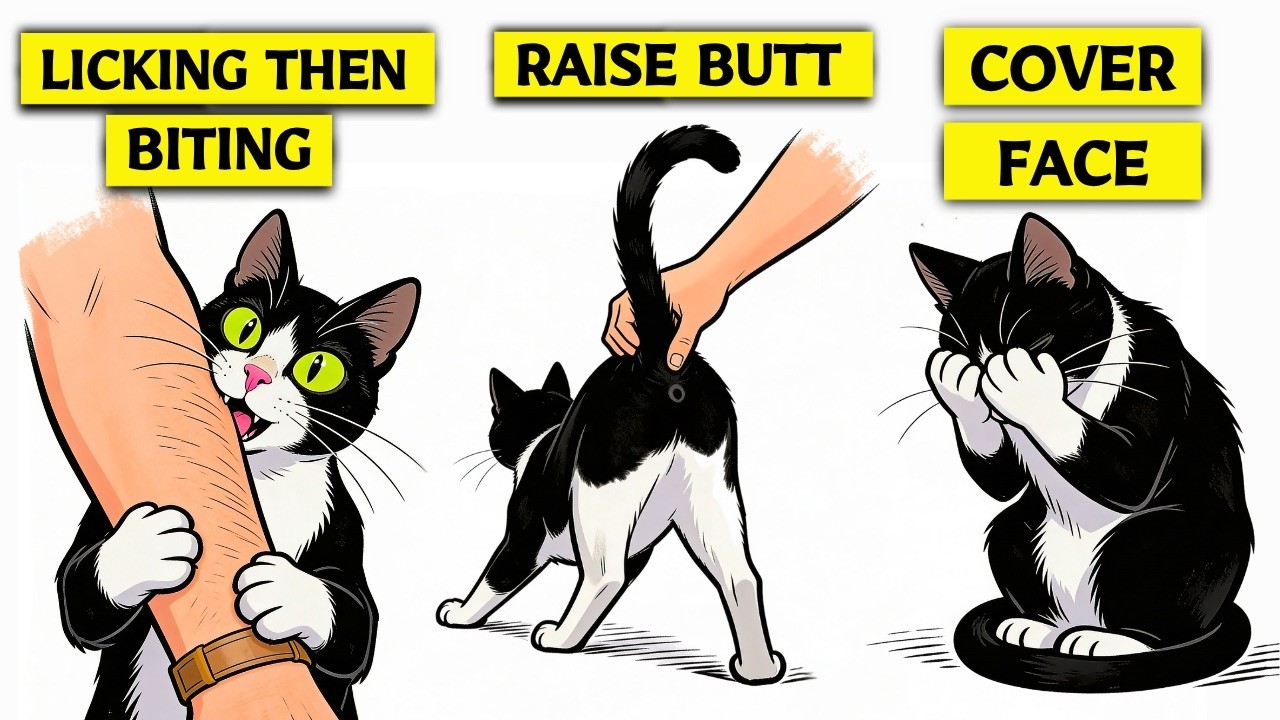
And when you don’t understand what they’re really saying, you might be accidentally pushing them away without realizing it. Here are seven strange cat behaviors and what they actually mean. —
You scratch your cat near the base of their tail and their whole backside goes straight up in the air. Most owners laugh it off.
But your cat isn’t being weird. They’re giving you one of the highest compliments they know how to give. That area at the base of the tail is packed with sensitive nerve endings. When you hit the right spot, it triggers an automatic response that goes all the way back to kittenhood.
Kittens raise their hindquarters so their mother can groom and clean them. It’s one of the earliest trust signals they ever learn. So when your adult cat does it for you, they’re saying you are safe enough to trigger that deep instinctive vulnerability. Here’s the layer most people miss.
Cats have scent glands right at the base of their tail. When they raise their butt toward you, they’re actively transferring their scent onto your hand. For a cat, that’s one of the deepest ways they can say you’re mine. A study published in the Journal of Veterinary Behavior found that cats who frequently solicit petting near the tail base showed higher overall trust markers with their owners compared to cats who avoided it.
So if your cat does this, you’re doing something very right. —
Ever caught your cat sitting by the window, jaw clicking rapidly, making that strange little sound that doesn’t quite sound like a meow? Most people assume their cat is frustrated. But the truth is way more primal than that.
That chattering sound is tied to your cat’s deep hunting instinct. Researchers at the Wildlife Conservation Society observed that wild cats in the Amazon mimic the calls of their prey to lure them closer. Your domestic cat is running that same ancient software. When they see a bird through the glass, their body switches into predator mode, and that jaw movement is believed to be a rehearsal bite.
Their muscles are literally practicing the kill sequence in real time. According to animal behaviorist Dr. Mikel Delgado, cats are incredibly hard to study in lab settings, which means this behavior still carries some mystery. What experts do agree on is that chattering happens most when prey is visible but unreachable.
It’s a mix of predatory instinct firing on autopilot and the frustration of not being able to act on it. They’re not angry. They’re locked in, completely focused. It’s the same kind of intensity a top athlete feels right before the whistle blows.
The next time your cat chatters at a bird, don’t worry that something is wrong. You’re witnessing one of the most raw, unfiltered moments of their true nature. It’s kind of an honor to see it. —
Why does your cat look you dead in the eye and push your glass right off the edge?
Are they doing it on purpose? Actually, yes. But not for the reason you think. Most people assume their cat is being destructive or trying to get attention.
Sometimes that plays a role, but the deeper reason goes back to something hardwired in their brain. Cats are natural investigators. In the wild, they survive by testing unfamiliar objects. Is it alive?
Is it dangerous? Will it move? That paw swipe at your water glass is the same instinct at work. They’re gathering information about their environment the only way they know how.
But here’s the part that might surprise you. Behaviorists believe that cats repeat this action because they’re learning cause and effect. Every time they push something and it falls, it creates a reaction. The object crashes, you come running, the whole room changes.
For a cat, that’s incredibly stimulating. They’re not being bad. They’re running little experiments. And you reacting every single time just confirms the experiment was worth repeating.
Don’t yell. Don’t punish. That only reinforces the attention loop. Instead, give them puzzle feeders or interactive toys that satisfy that same investigative drive.
Redirect the instinct and you’ll save your countertops and your sanity. —
Have you ever walked in on your cat sleeping with their paw draped right over their eyes? It might be the most adorable thing they do, but is there actually a reason behind it? Turns out it’s very intentional.
One of the main reasons cats cover their face while sleeping is to block out light. Cats are crepuscular, meaning they’re most active at dawn and dusk. So when they’re trying to get deep rest during the middle of the day, that paw over the eyes works like a built-in sleep mask. They’re protecting the quality of their rest the only way they can.
But there’s another layer to it. When a cat covers their face, they’re also tucking away their most vulnerable features. Their eyes, nose, and whiskers are some of the most sensitive parts of their entire body. Covering them is a self-soothing behavior that signals your cat feels safe enough to let their guard down, but still wants that extra layer of comfort.
Think of it like a person pulling a blanket up over their face. You’re not scared, you just feel more settled that way. That position also helps them conserve body heat. Cats lose warmth through their nose and ears, and curling up with their face covered keeps that warmth trapped close.
Comfort, safety, and survival instinct all rolled into one tiny heart-melting pose. —
Has your cat ever been licking your hand, totally calm, and then out of nowhere just chomped down on you? What did you do wrong? The answer might actually be nothing.
That lick-then-bite combo is one of the most misunderstood things cats do. Most owners take it personally, like their cat suddenly turned on them. But what’s really happening is a lot more nuanced. When your cat licks you, they’re grooming you.
That’s a bonding behavior. They’re treating you like family. But cats have a very low threshold for sensory input. What starts as affection can quickly become overstimulation.
And that bite is their way of saying, “I love you, but I’m done now. ”
The tricky part is that cats don’t give obvious warning signs the way dogs do. There’s no growl, no pulled-back ears every time. Sometimes the only signal is a very subtle stiffening of their body or a slight flick of the tail right before it happens.
Dr. Sharon Crowell-Davis, a veterinary behaviorist at the University of Georgia, has noted that this kind of petting-induced overstimulation is one of the most common causes of sudden biting in otherwise affectionate cats. It’s not aggression. It’s a boundary.
If you pull away harshly or scold them, you’re punishing your cat for communicating. Over time, that teaches them that telling you how they feel isn’t safe. Instead, learn to read those tiny shifts. When the bite comes, just calmly stop.
No reaction, no drama. That’s how you teach your cat that their boundaries are respected, and that’s how the bond actually gets stronger. —
Why does your cat suddenly sprint through the house in the middle of the night like they’re being chased by something you can’t see? Is something wrong with them?
Not even close. In fact, it’s one of the healthiest things they can do. Those late-night bursts of energy, sometimes called the zoomies, come down to biology. Cats are crepuscular hunters.
Their bodies are wired to be most active during dawn and dusk, not during the hours you’ve scheduled for them. So while you’ve been asleep since 11:00, your cat’s internal clock just hit peak performance mode. That explosion of running, sliding, and knocking things over is their body releasing stored energy the way nature designed it. But here’s the thing most owners don’t realize.
If your cat is zooming every single night with serious intensity, it might mean they’re not getting enough stimulation during the day. Indoor cats especially need an outlet for that predatory energy. Without it, all of that drive builds up with nowhere to go until the house gets quiet and their instincts take over. It’s not chaos.
It’s a pressure valve. The fix is simpler than you’d think. A solid 15-to-20-minute play session before bed, especially with a wand toy that mimics prey movement, can burn off that energy before it turns into a 3:00 a. m.
marathon. Follow the play session with a small meal, and you’re tapping into their natural hunt, catch, eat, sleep cycle. Do it consistently, and your nights will get a lot quieter. —
Have you ever caught your cat sitting completely still, just staring at you without blinking?
No sound, no movement, just locked in on you like they’re trying to see through you. It can feel unsettling. But remember when we talked about what it means when your cat raises their butt towards you? That was trust through touch.
This one is trust through eye contact, and it might be the most powerful version of it. In the animal world, direct eye contact is usually a threat. It’s a challenge. Most animals, including cats, avoid prolonged staring because it signals aggression.
So when your cat holds a long steady gaze at you without breaking it, they’re doing something they would never do with an animal they didn’t fully trust. They’re dropping every defense they have. No look away, no flinch, just complete openness. And here’s where it gets even deeper.
If that stare is followed by a slow blink, you’ve just received what animal behaviorists call a cat kiss. Dr. Tasmin Humphrey and her team at the University of Sussex published a study in 2020 showing that cats are more likely to slow blink at their owners after their owners slow blink at them first. It’s a two-way conversation.
Your cat isn’t just tolerating you. They’re choosing to communicate affection in the most vulnerable way they know how. The next time your cat sits there staring at you, don’t look away. Slow blink back.
Hold that moment. Because in that silence, without a single sound, your cat is telling you everything you’ve ever needed to hear.