You woke up and your cat wasn’t in any of their usual places. Not the back of the couch. Not the sunny square on the kitchen floor. You called their name, waited, then found them under the bed, pressed into the darkest corner.
When you reached for them, they flinched. Small. Quick. Automatic.
You love this animal. You have fed them, sheltered them, bought them toys. And still, somewhere deep in their body, something says get away. It’s not because they’ve stopped loving you.
It’s because you’ve been saying “I love you” in a language they were never taught. Most owners never learn this. They keep doing the same things, day after day, wondering why their cat stays distant. The truth is that the love you give sometimes lands all wrong.
There are seven small habits that fix it. Each one takes less than a minute. And once you start, your cat won’t just trust you. They’ll love you back.
Start with the way you talk to them. You’ve caught yourself doing it a hundred times. That high, soft, slightly ridiculous voice you’d never use anywhere else. It comes out the second you see them, and then you feel embarrassed, so you stop.
But the science says you should lean in. A study from the University of Paris found that cats can actually tell their owner’s voice from a stranger’s voice. But only when the owner uses that sweet, exaggerated, baby tone. When owners spoke in their normal adult voice, the cats barely reacted.
The moment they switched to that gentle, silly voice, the cats perked up. They turned their heads. They moved closer. Your cat isn’t just hearing sounds.
When you soften your voice, they recognize you. Something clicks that doesn’t click when you speak like a coworker or a stranger on the phone. So talk to them every day. When you feed them.
When you walk past them. When you catch them watching you from across the room. Say anything. The words don’t matter.
What matters is the tone. Soft, warm, low, safe. That voice tells your cat: you are safe with me. And if you think that’s powerful, wait until you see what happens next.
Because there’s a three-second look that changes everything between you and your cat. Have you ever caught them staring at you and then slowly closing their eyes? Most owners think the cat is sleepy. But a slow blink is one of the most intentional things a cat can do.
And it’s aimed at you. Researchers at the University of Sussex tested it in 2020. When owners slow blinked at their cats, the cats were significantly more likely to slow blink back. Some of them even walked over.
Strangers got a positive response too, but the effect was strongest with owners. Just that tiny gesture changed how the cat felt about the person in front of them. No treat. No toy.
No belly rub. Just three seconds of eye contact followed by a slow, deliberate lowering of the eyelids. Your cat reads it as: I’m not a threat. I love you.
Here’s why this matters for you: most of us stare at our cats without realizing what we’re doing. In cat language, direct eye contact with no blink is a challenge. It’s confrontational. Every time you lock eyes with your cat and don’t blink, you might be sending the exact opposite message of what you feel.
So make this part of your routine. Every morning, every evening, whenever your cat meets your eyes, let your eyelids drop and hold them there for a second. If they blink back, that’s your cat saying: I trust you with my life. Then there’s the way you play.
You’ve dangled a toy in front of your cat and watched them stare at you like you’re embarrassing yourself. You thought they were lazy. But your cat wasn’t lazy. They were bored out of their mind.
Cats are hardwired hunters. Their brains are built to stalk, chase, pounce, and catch. That sequence is everything to them. When you wave a toy back and forth in the same spot at the same speed, you skip every step that makes play feel real.
So change the game. Move the toy like prey. Drag it away from them, not toward them. Let it hide behind a corner.
Make it freeze. Then make it dart. Move in unpredictable bursts. Watch what your cat does when you do this.
Their body drops low. Their pupils go wide. Their tail flicks. That’s not just excitement.
That’s something primal being switched on. A cat who gets a real hunt every day becomes calmer, more affectionate, and more bonded to the person who gives them that experience. You become the source of their deepest instinct being fulfilled. Five to ten minutes a day is enough.
But those minutes have to feel real. Stop shaking the toy like it’s a chore. Start moving it like something worth catching. Your cat will never look at you the same way.
And then there’s the habit that feels like doing nothing. Most owners think bonding means petting, playing, treating, or talking. So when they sit on the couch and their cat is across the room, they feel like nothing is happening. But something huge is happening.
Your cat is watching you. In the wild, cats only rest near other cats they fully trust. They don’t cuddle the way dogs do. They share space.
That’s it. When one cat chooses to rest near another cat, it’s a quiet signal: I trust you enough to be vulnerable around you. So when you sit near your cat without reaching for them, without calling their name, without trying to make something happen, you’re telling them: I don’t need anything from you. I just want to be here.
For a cat, that’s everything. Do this every day. At first, your cat might keep their distance. But over time, that distance gets smaller.
They’ll move into the same room. Then the same couch. Then right next to you. Not because you asked.
Because they chose you. And in the world of cats, being chosen is the highest form of love there is. But before you reach out to pet them, stop. Think about how you greet your cat when you walk into a room.
Be honest. Do you just bend down and start touching them? If so, you’re skipping a step your cat has been waiting for you to learn your whole life. Cats don’t process the world through sight first.
They process it through scent. Every interaction starts with the nose. When two bonded cats greet each other, they don’t just walk up and start grooming. They touch noses first.
That tiny exchange of scent is basically a handshake. It says: I know you. You’re safe. Now think about what happens when you skip that and go straight for the head scratch.
To your cat, it’s like someone you barely recognize walking up and hugging you with no warning. It’s not painful. But it’s jarring. And over time, it teaches your cat to flinch instead of lean in.
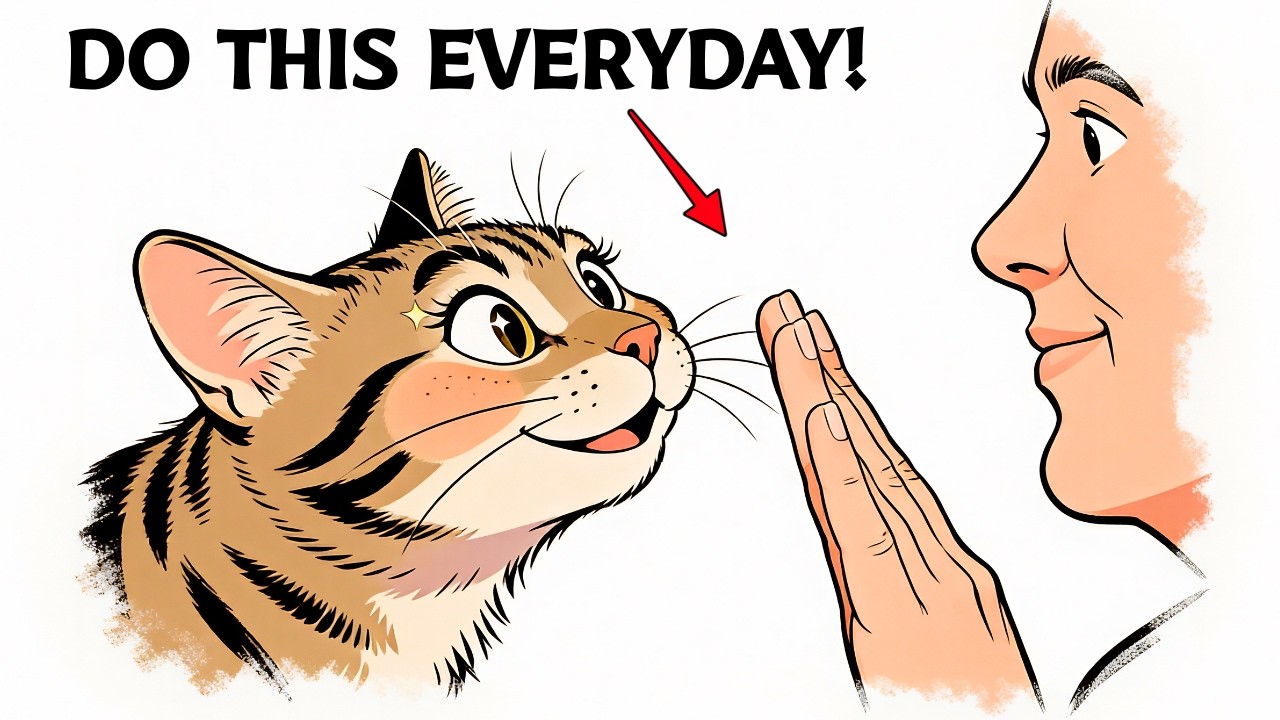
Here’s the habit. Every single time you’re about to pet your cat, extend one finger. Hold it a few inches from their nose. Let them come to it.
Let them sniff. Let them process you. When they push their face into your hand or rub their cheek against your finger, that’s your green light. That’s your cat saying: okay, I’m ready.
It takes two seconds. But those two seconds change how your cat experiences your touch. You go from someone who pets them to someone who asks first. And cats never forget the people who ask first.
There’s one more mistake that cuts deeper than the rest. Think about every time you scooped up your sleeping cat because they looked too cute to resist. They were curled in that perfect little ball. Their guard was down.
Their muscles were loose. And something in your brain said: I need to hold that right now. What feels like love to you feels like something else to them. Cats spend twelve to sixteen hours a day sleeping.
Not because they’re lazy. Sleep is how their bodies recover, process stress, and regulate their nervous system. Deep sleep is when they feel most vulnerable. They chose that spot because they felt safe enough to disappear from the world for a while.
Now imagine what happens when you interrupt that. They’re lying there, completely defenseless, and suddenly they’re lifted into the air with no warning. Their heart rate spikes. Their claws come out.
Even if they settle into your arms a few seconds later, something has been registered: that spot isn’t as safe as I thought. Do this enough times and you’ll notice the result. Your cat starts sleeping in harder to reach places. Under the bed.
On top of shelves. Behind furniture. They’re not being antisocial. They’re protecting their sleep from the one person who keeps interrupting it.
The simplest habit here is to just walk past your sleeping cat. Let them rest. If you want to show love, show it by leaving them alone when they’re at their most open. That restraint means more to them than any squeeze.
And then there’s the one thing that unlocks everything. Earlier, I said there’s a spot on your cat’s body that triggers something deeper than your voice ever could. This is it. And once you know it, you’ll never pet your cat the same way again.
When deeply bonded cats groom each other, they don’t lick just anywhere. They focus almost exclusively on one place: the base of the head, right between and behind the ears. That’s the spot a cat can never reach on its own. So the only way they ever get groomed there is by someone they trust completely.
That’s why this spot is different from every other place you pet. The belly is vulnerable. The chin feels good. But the area between the ears and down the back of the head is reserved.
It’s family only. When one cat grooms another in that spot, oxytocin is released in both cats. Not just the one being groomed. Both.
It’s a chemical bond that says: we belong to each other. You can trigger the same response. Every day, take a few seconds to gently stroke that spot between your cat’s ears with your fingertips. Don’t scratch.
Don’t press hard. Use slow, gentle, repetitive strokes, the rhythm another cat’s tongue would use. Then watch what happens. Your cat’s eyes will close slowly.
Their body will soften. Their purr will shift into something deeper than a normal petting purr. That’s not just comfort. That’s your cat’s brain releasing the exact same chemical it would release with a bonded family member.
All those little signals you thought were just sleepiness or random affection? They were invitations. And now you know how to answer them. Start tomorrow morning.
Walk past your sleeping cat and don’t touch them. When they wake up, talk to them in the soft voice you thought you should be embarrassed about. Sit near them without reaching out. Let them smell your finger before you pet them.
Slow blink when they look at you. And when they finally press the top of their head into your hand, let your fingers find that spot behind their ears. Stroke gently. Stay there for as long as they want.
Your cat will close their eyes. They’ll lean into you. They’ll choose the same room, the same couch, the same lap, over and over again. Not because you forced anything.
Because you finally learned to speak their language. And once that happens, your cat won’t just trust you. They’ll love you back with the full weight of their small, complicated heart.