Why Your Cat Suddenly Bites You While Cuddling 🐱
Everything is perfect. Your cat is curled against you, purring, eyes half closed, completely melted into your lap. The warmth of their body, the slow rhythm of their breathing, the way they press just a little harder into your hand with every stroke.
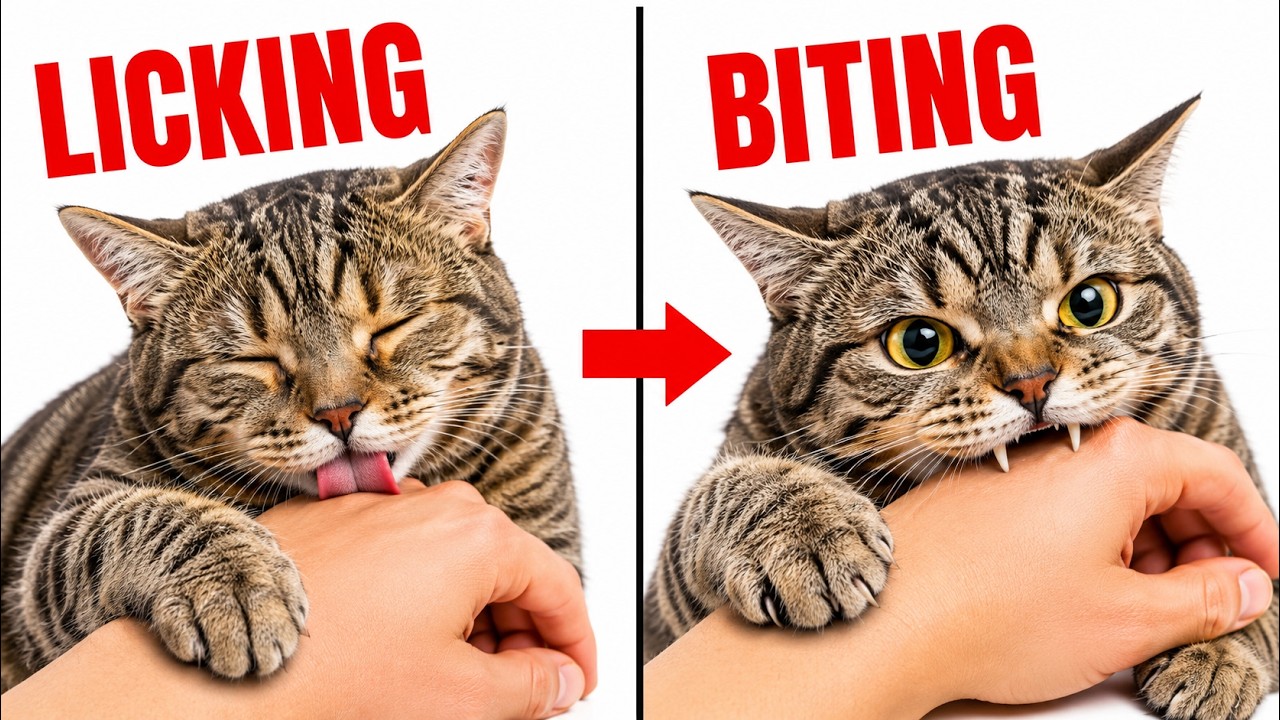 It’s the softest moment you’ve had together all day. Then, out of nowhere, they bite you. Not a scratch.
Not a swat. Their teeth close around your hand right in the middle of everything that felt so good.
You probably think you did something wrong. You pulled away too fast. You pet too hard.
You ruined the moment. Maybe you even apologized to your cat afterward for something you didn’t actually do. But here’s what most owners never find out.
That bite might be the most honest thing your cat has ever told you. And by the end of this article, you’ll know the one signal that comes right before it. A signal almost every owner misses every single time it happens.
You felt this. The confusion. The little sting of rejection right in the middle of something that felt so good.
But here’s the part that changes everything. Your cat isn’t pulling away from you. Their body is pulling away from itself.
Point one. Their skin is speaking a language you can’t hear.
When your cat leans into you and goes quiet, you assume that’s the finish line. The goal achieved. Most people think more petting means more love.
More strokes. More closeness. More connection.
Simple math. But your cat’s skin is counting. Every stroke sends a small electrical signal through their nerves, and each one stacks on top of the last, building toward a threshold you can’t see and they can’t control.
It’s not that your hand changed. It’s that their body has been quietly keeping score the entire time. Researchers who study touch receptors in cats have found that the same stroke that feels good at second one can feel like static by second sixty, even though nothing about the petting itself has changed.
The stroke is identical. The hand is identical. The only thing that changed is the accumulation.
Think about what that actually means. The bite isn’t a reaction to anything you did in that moment. It’s a reaction to everything that came before it.
Affection has a ceiling, even when the love doesn’t. That’s not rejection. That’s a body reaching its limit.
Most owners never connect the dots. They notice the bite. They never notice the hour of cuddling that led to it, the slow build that made it inevitable.
And there’s one more thing, something I’m saving for the end of this article, because it’s the moment most owners only recognize after they’ve already missed it a hundred times.
 Point two. The warning you’ve been missing the whole time.
Right before that bite, your cat’s body changes. You just don’t know what you’re looking at. You think the bite came out of nowhere.
It didn’t. The tail gave a slight flick. The ears turned slightly back.
The skin along their spine rippled like a wave passing under fur. None of that is subtle to a cat. To another cat, those signals would be impossible to miss.
Your cat was shouting in the only language they have.
Animal behaviorists who study petting-induced overstimulation have mapped this exact sequence. Tail flick. Ear rotation.
Skin twitch. Almost always in that order. Almost always seconds before a bite.
The researchers weren’t surprised that cats do this. They were surprised at how many owners never see it, even on video, even in slow motion, even after watching it happen a dozen times.
You weren’t ignored. You just weren’t listening yet. And once you learn to see those three signals, something shifts.
You stop getting bitten as a surprise. You start getting a half second of warning every time. And that half second is enough.
Enough to slow down. Enough to shift your hand to a calmer spot. Enough to let your cat reset before things tip over.
If you’ve ever felt that little ripple under your hand and kept petting anyway, you’re about to feel very seen.
Point three. What your cat’s mother taught them about love.
Why would a cat who trusts you ever close their teeth around your hand? To answer that, you have to go back to the very beginning, long before your cat ever curled up on your lap. You think affection and aggression live on opposite sides of your cat’s mind, like two rooms with a locked door between them.
They don’t.
Before your cat could even open their eyes, their mother was already doing two things at once. Licking them and gently nipping them in the same breath, over and over. The licking cleaned them and calmed them.
 The nipping moved them, corrected them, kept them close. That pairing, lick and bite, together from the one creature they trusted most, became the first language of love they ever learned. Developmental studies on kitten behavior describe this licking and nipping pattern as one of the earliest bonding rituals a cat experiences, happening before vision, before walking, before almost anything else.
Sound familiar? What looks like a contradiction to us was never a contradiction to them. There was no version of love in their earliest memory that didn’t include both.
It’s the only blueprint they were ever given. And every cat, no matter how independent they seem now, carries that blueprint somewhere underneath. So when your adult cat licks you, then gently closes their mouth around your hand, they may be running the oldest program they have.
The bite isn’t the opposite of the cuddle. It’s the rest of the sentence.
Remember what I said at the start about the one moment right before the bite, the one almost no one catches? We’re getting close.
Point four. I love you too much versus I’m done.
Two bites can look exactly the same. Same teeth. Same speed.
Same spot on your hand. But they can be saying completely different things. You think every bite means stop, I’m upset, back off.
Sometimes it does. But sometimes, especially after a long slow cuddle session, that bite isn’t a complaint at all. It’s your cat closing the moment the way you’d close a chapter you were happy with.
Not because it was bad. Because it was complete.
Research on allogrooming, the mutual grooming bonded cats do for each other, has found that these sessions almost always end the same way. One cat gently bites the other, and they both simply walk away, relaxed. And this happens in your home every single night in the quiet moments you’ve probably stopped noticing.
Your cat isn’t telling you the moment failed. They’re telling you it’s finished, and it was good enough to finish on purpose instead of just fading out. Think about how rarely that happens between two creatures who trust each other.
An ending that’s chosen, not forced. That’s not an ending. That’s punctuation.
Point five. The one thing cats almost never do until they trust you completely.
Remember in point one when I said your cat’s body is reaching a limit? This is that moment. So what is that one signal?
The one almost no one catches? Some cats tense up right before they bite. Shoulders tight.
 Body coiled. Muscles loading, ready to move the second it’s over. But the cats who trust you most don’t tense at all.
They go soft. Completely soft. Heavy.
Loose. Almost asleep. For just a moment, right before the bite, as if every muscle simply let go at once.
Studies on bonded cats describe a brief full body release just before an overstimulation bite. Muscles dropping. Weight sinking.
As if the cat has stopped holding itself up at all. And this happens in your home every single night, and you’ve probably never noticed it because it lasts less than a second. In that half second, the one right before the bite, your cat isn’t bracing for a fight.
Think about what that half second usually means for a cat. A creature whose entire survival depends on never being caught off guard, never being fully relaxed near anything bigger than them. Letting all of that go on purpose near your hand.
Every guard they have is down. Every instinct that would normally protect them goes quiet. And in that moment, with their whole body open and unguarded, they choose you.
Not the edge of the couch. Not the floor. Not somewhere safer.
You. That’s not a warning. That’s surrender.
And in that moment, it’s tempting to keep going. To hold them a little longer because it feels so good, because they’re so soft, because you don’t want it to end either. But there’s something most people get wrong here.
If you push past that soft, heavy stillness, the bite gets harder. Not because your cat is angry, but because their body has no other way left to ask for space. When you feel them go that still, that heavy, that’s your cue, not your loss.
Loosen your hold first. Let them choose to stay or go. Let them leave soft.
They’ll come back softer.
That bite was never about you doing something wrong. It was your cat’s body telling the truth their heart couldn’t say in words. The same truth their mother told them in the same language before they ever knew there was another way.
The most honest creatures in your home are the ones who can’t lie to you, even when they wish they could stay a little longer. Has your cat ever gone soft like that right before they bit you? And did you know, even then, that it meant they trusted you completely?