When you pour dry food into your cat’s bowl every morning, do you actually know what it’s doing to their body? It’s convenient. It’s affordable.
And your cat seems to love it. But behind that crunch, there’s something happening inside them that most owners never see. Dry food changes your cat in ways that go far beyond nutrition.
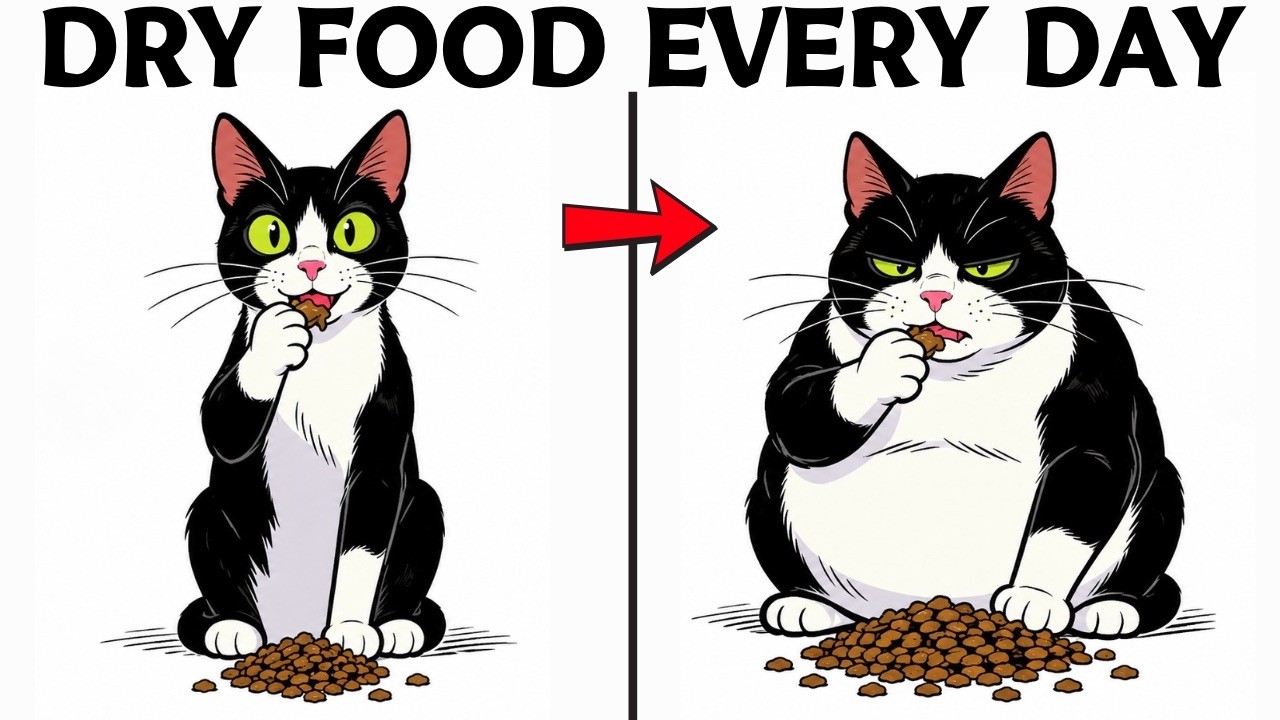 And if you keep feeding it the same way most people do, you could be quietly cutting years off the life of a cat who trusts you to get it right.
Here’s what’s really going on every time they eat from that bowl.
One, they live in a state of constant dehydration. Have you ever noticed your cat barely touches their water bowl? Most owners think their cat just isn’t thirsty, but the truth is, your cat is thirsty.
They just don’t know it.
Cats evolved in the desert. Their ancestors got almost all of their water from the prey they caught. We’re talking about 70 to 80 percent moisture in every meal.
Their bodies were never designed to make up the difference by drinking from a bowl. That instinct simply isn’t strong enough.
A study published in the Journal of Feline Medicine and Surgery found that cats fed exclusively dry food consumed significantly less total water than cats on wet diets, even when fresh water was freely available. Their bodies simply aren’t built to compensate by drinking.
Now, take dry food. It contains roughly 10 percent moisture. That means every single meal leaves your cat running on a fraction of the water their body actually needs.
And here’s the thing. They won’t show obvious signs. They won’t cry.
They won’t act dramatic about it. They just quietly exist in a low-grade state of dehydration day after day, meal after meal.
Their urine gets more concentrated. Their skin loses elasticity. Their energy dips in ways you’d never connect to their food.
And what makes this so serious is what that constant dehydration is quietly doing to one specific organ over time. We’ll get into that in the last part of this article, and when you hear it, you’ll understand just how much your cat’s life could be at risk.
Two, their blood sugar spikes after every meal. What if every meal you gave your cat was silently pushing them toward a disease they were never supposed to get? Cats are obligate carnivores.
Their entire biology is built to run on protein and fat. Carbohydrates were never part of the plan.
In the wild, a cat’s natural diet contains less than 2 percent carbs. Now, look at the back of most dry food bags. You’ll find carbohydrate levels sitting somewhere between 30 and 50 percent.
That’s not a small gap. That’s a completely different fuel source than what their body was designed to process.
 Every time your cat eats a bowl of dry food, their blood sugar spikes in a way that would never happen on a natural diet. Their pancreas has to pump out insulin to deal with it. And then a few hours later, it happens again and again.
Day after day, year after year, that pancreas is working overtime on a job it was never built for.
Research published in the Journal of the American Veterinary Medical Association found that cats fed high-carbohydrate diets showed significantly higher insulin responses compared to those on high-protein, low-carb meals. Over time, this chronic pattern dramatically increases the risk of developing type 2 diabetes.
And here’s what breaks my heart. Most owners don’t find out until their cat is already sick. By then, you’re looking at daily insulin injections, expensive vet visits, and a problem that could have been avoided by simply understanding what was in the bowl.
Three, they gain weight in a way that’s hard to reverse. Why do so many indoor cats end up overweight when their owners swear they’re not overfeeding them? Here’s the problem.
Dry food is one of the most calorie-dense things you can put in front of a cat. A small bowl that looks like nothing holds way more energy than your cat needs in an entire day.
And because dry food is loaded with carbohydrates, their body doesn’t use that energy the way it would with protein. Instead of building lean muscle and burning fuel efficiently, those extra carbs get converted straight into fat storage. It’s the same thing that happens in humans on high-sugar diets.
The weight doesn’t come from eating too much. It comes from eating the wrong thing.
Now add free feeding into the mix, which is what most dry food owners do. You leave the bowl out. Your cat grazes all day.
And there’s no real way to track how much they’ve actually eaten. You think they’re eating small amounts. They think the buffet is always open.
And unlike dogs, cats don’t always eat out of hunger. Boredom, stress, routine. They’ll eat for all of it.
The worst part is that once a cat gains that weight, getting it off is brutally hard. You can’t just put them on a diet the way you would with a dog. Cats that lose weight too fast can develop hepatic lipidosis, a life-threatening liver condition.
So you’re stuck in this impossible spot where the weight is dangerous, but losing it too quickly is also dangerous. And it all started with a bowl of food that looked completely harmless.
Four, they become chemically hooked on the coating. Have you ever tried switching your cat to wet food or raw food and watched them look at you like you just insulted their entire bloodline? That’s not your cat being picky.
That’s your cat being hooked.
 Most people don’t know this, but dry kibble on its own tastes like cardboard. Cats would barely touch it. So manufacturers spray the outside with something called animal digest, a concentrated flavor coating made from chemically broken down animal tissues.
It’s engineered to be irresistible. Not nutritious, not natural, just irresistible.
Think of it like seasoning a bad meal so heavily that all you taste is the seasoning. That’s what your cat is eating for. Research from the British Journal of Nutrition found that palatability coatings are the single biggest factor in whether a cat accepts or rejects a food, outweighing actual nutritional content entirely.
In other words, your cat isn’t choosing what’s good for them. They’re choosing what was engineered to trick them.
And the longer your cat eats nothing but dry food, the deeper that preference gets wired in. Cats who grow up on kibble from kittenhood often reach a point where they flat-out refuse anything else. You put a bowl of fresh, high-quality wet food in front of them, and they act like you’re trying to poison them.
It’s not stubbornness. It’s conditioning. Their brain has learned that food equals that specific flavor profile, and anything outside of it doesn’t register as food at all.
This is why so many owners give up trying to switch. They think their cat just doesn’t like wet food. But the truth is, their cat was never given a fair chance to try it.
And the longer you wait to introduce variety, the harder and slower the transition becomes.
Five, the cleans their teeth thing is a myth. How many times have you heard someone say dry food is good for your cat’s teeth? It sounds like it makes sense.
Hard food. Crunching action. Scraping plaque off.
Logical, right? Except it doesn’t actually work that way.
Watch your cat eat kibble sometime. They don’t chew it the way you’d chew a carrot. Most cats barely crunch at all.
They either swallow the pieces whole or shatter them into fragments that skip past the teeth entirely. There’s no sustained scraping. There’s no contact along the gum line where plaque actually builds up.
It’s like saying pretzels clean your teeth because they’re crunchy.
A study published in the Journal of Veterinary Dentistry found no significant difference in dental disease between cats fed dry food and cats fed wet food. The idea that kibble cleans teeth has been repeated so many times that most people treat it as fact. But the research simply doesn’t back it up.
 And here’s the part that really gives it away. The pet food industry itself knows regular kibble doesn’t clean teeth. That’s exactly why they had to create prescription dental diets, special oversized pieces made with a unique fiber matrix that forces the tooth to sink all the way in before the kibble breaks apart.
Regular kibble doesn’t do any of that. It shatters on first contact. If normal dry food actually cleaned teeth, dental-specific diets wouldn’t need to exist.
And on top of all that, dry food is loaded with starch. That starch breaks down into sugars that stick to the teeth and feed the exact bacteria responsible for plaque and tartar buildup. So not only is dry food not cleaning their teeth, it may actually be making the problem worse.
The one thing so many owners believe is protecting their cat’s mouth could be doing the exact opposite.
Six, their kidneys quietly deteriorate. Remember earlier when we talked about your cat living in a constant state of dehydration? Here’s where that story ends, and it’s the part every cat owner needs to hear.
Your cat’s kidneys are responsible for filtering waste out of the blood and flushing it out through urine. To do that properly, they need water, a lot of it. When a cat is chronically dehydrated from a lifetime of dry food, those kidneys don’t just slow down.
They’re forced to hyper-concentrate every drop of urine to compensate. Day after day, month after month, year after year, those kidneys are working harder than they were ever designed to.
And the cruel part is, you won’t know it’s happening. Kidney tissue doesn’t regenerate. It doesn’t send pain signals.
It just quietly loses function in the background while your cat eats, plays, and acts completely normal. By the time blood work catches it, your cat has already lost roughly 65 to 75 percent of their kidney function. That’s not early detection.
That’s damage control.
Chronic kidney disease is the leading cause of death in cats over the age of 10, not cancer, not heart disease, kidney failure. And research published in the Journal of the American Veterinary Medical Association found that cats fed moisture-rich diets had significantly better kidney values over time compared to those on dry-only diets. That’s not coincidence.
That’s a direct line between what goes in the bowl and how long your cat gets to stay with you.
The part that stays with me is that this is one of the few things owners actually have the power to change. You can’t control genetics. You can’t stop aging.
But you can control what’s in that bowl. And sometimes, that one decision is the difference between losing your cat at 12 and having them with you at 20.