When you keep your cat indoors for their whole life, do you actually know what it’s doing to them? Most owners carry a quiet guilt about it. That guilt is built on a myth.
What’s really happening inside your cat is the opposite of what you fear. And if you keep believing you’re depriving them, you might miss what they’ve been trying to give you all along.
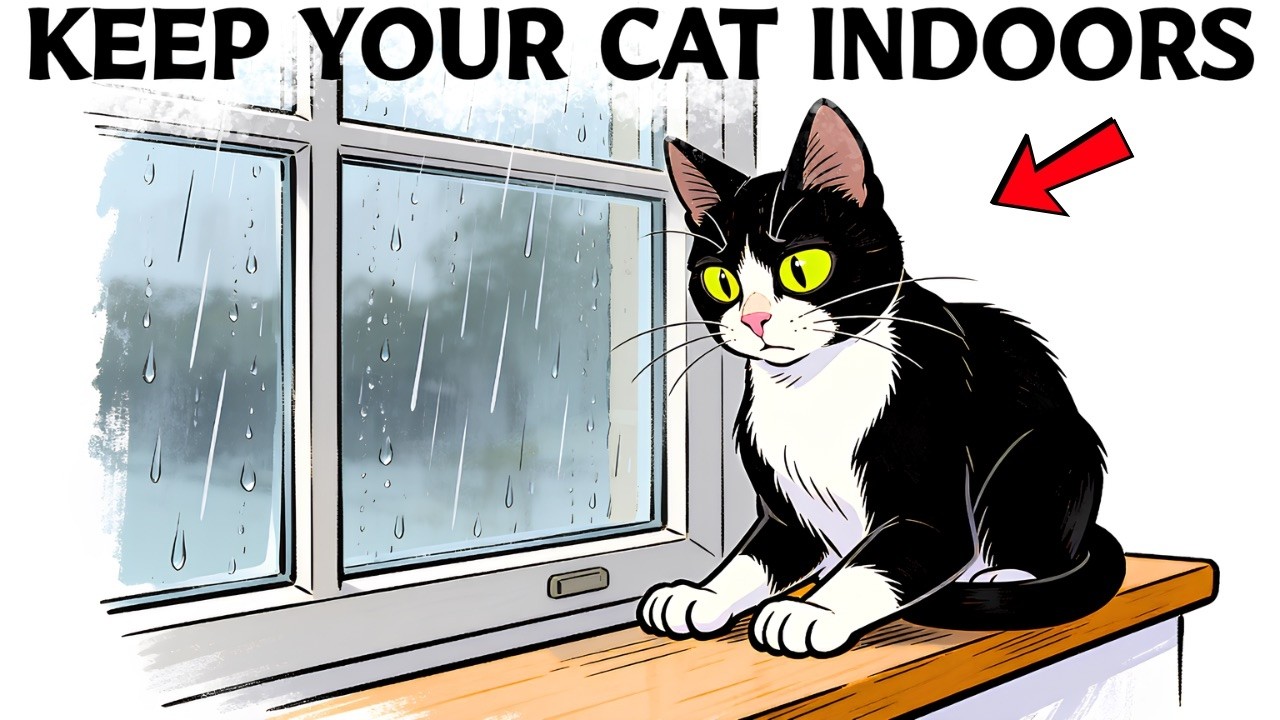 Let’s start with the one fact that changes everything.
One, they live years longer than you think. How much longer do you think an indoor cat lives compared to one that roams outside? Here’s the honest answer.
Indoor cats regularly live 12 to 18 years, and plenty make it into their 20s. For cats with outdoor access, nobody can give you a reliable number. And the reason why is the disturbing part.
So many outdoor cats simply disappear that their deaths never get recorded. No vet visit, no cause of death. Just an empty food bowl and a question that never gets answered.
The statistics are incomplete because the cats themselves go missing from them. But if you want to get a glimpse of what the outside world does to a cat, look at the ones who live in it full-time. Stray and feral cats with no one caring for them often survive only two to five years.
Many don’t even make it that far.
Same species, same instincts. The only difference is a door. That’s how dangerous it is out there.
And once you understand why, you’ll never second-guess your choice again.
Outside, your cat isn’t the predator they think they are. To a car at night, they’re invisible. To a coyote or a loose dog, they’re prey.
To a tick, a flea, or another cat carrying feline leukemia or FIV, they’re just the next host. Then there’s antifreeze, which tastes sweet to cats and is lethal in tiny amounts. Rat poison hidden in neighbors’ garages.
Fights over territory that leave wounds owners never see until they’ve turned serious.
Here’s the part that gets me. None of these dangers announce themselves. An outdoor cat doesn’t get a warning.
One evening, they just don’t come home, and the owner spends years wondering what happened. Your indoor cat will never be that story. Every single one of those threats you’ve already erased from their life, not by luck, by one decision you made and kept making every single day, every time you close that door behind you.
And here’s what almost nobody tells you. There’s one thing your cat will never be able to tell you, no matter how much they trust you, not because they don’t want to, because an instinct older than their species won’t let them. And there’s exactly one thing that beats that instinct, and it only works because your cat lives indoors.
 I’ll show you what it is in the final topic, because one day it might save their life.
Two, you always know exactly where they are. Do you know what every owner of an outdoor cat does at some point, usually late at night? They stand at the door calling a name into the dark, waiting for a shape to appear at the edge of the porch light.
Sometimes the shape shows up, sometimes it doesn’t, and the not knowing is its own special kind of torture. You’ve never had to live that, and it’s easy to forget what a gift that is, because peace of mind is invisible. You only notice it when it’s gone.
Think about what your version of that moment looks like instead. You want to know where your cat is? They’re on the couch, or in the sun spot by the window, or sitting on the exact document you needed, because of course they are.
The worst case scenario in your home is that they found a new hiding spot behind the closet, and you get 30 seconds of mild panic before a pair of judgmental eyes peers out at you.
But here’s what’s really happening underneath, and this is the part most people never connect. That certainty flows both ways. Your cat always knows where you are, too.
Their entire territory, the thing a cat’s brain is built to monitor and secure, is fully mapped, fully controlled, and fully shared with you. No rival cats crossing through, no strange smells to investigate at the border. In their mind, they don’t live in a smaller world, they live in a solved one.
And a cat with a solved world doesn’t spend their energy on survival, they spend it on you.
Three, their bond with you grows deeper indoors. Have you ever wondered why your cat follows you from room to room or talks to you like you’re supposed to understand every word? Here’s something wild.
Adult cats barely meow at each other. Meowing is a language they develop almost entirely for humans, and indoor cats become downright fluent in it. That’s not an accident.
It’s what happens when you become the most interesting thing in their territory.
An outdoor cat splits their attention across an entire neighborhood. Rival cats to monitor, borders to patrol, prey to track. Their human gets whatever focus is left over, which is why so many outdoor cats treat home like a hotel: check in, eat, sleep, check out.
The relationship is real, but it’s one of many. Your indoor cat made a different investment. All of that social energy, the watching, the learning, the communicating gets concentrated on you.
 That’s why they know the sound of your car, why they’ve memorized which footsteps mean food and which mean you’re just getting water, why they show up at the door before you’ve even touched the handle. Researchers have found that most cats form genuine attachment bonds to their owners, much like young children do with parents, seeking them out as a source of safety. And that bond gets its richest expression when you’re the center of their world instead of a stop along the patrol route.
Here’s the reframe I want you to sit with. People say indoor cats depend on their humans like it’s a flaw, but dependence in a relationship built on trust has another name. It’s called closeness.
So, the next time your cat yells at you for absolutely no reason at six in the evening, understand what’s actually happening. They built a language just for you. Not bad for an animal everyone calls independent.
But if the bond is this deep, it raises an uncomfortable question. Aren’t they still missing something out there? That’s where we’re going next, and the answer is not what you think.
Four, they are not missing out the way you think. What do you picture when you imagine your cat’s dream life? Rolling in grass, chasing butterflies through a meadow at golden hour.
Here’s the uncomfortable truth about that image. It’s yours, not theirs. You’re imagining what freedom means to a human and projecting it onto an animal whose brain works nothing like ours.
So, let’s decode what a cat actually needs to feel content, because it’s surprisingly specific. A cat’s sense of well-being is built on three pillars: secure territory, predictable resources, and control over their environment. Notice what’s not on that list.
Novelty, adventure, open horizons. Those are human cravings. To a cat, the unknown isn’t exciting.
The unknown is a threat that hasn’t introduced itself yet. That’s why your cat inspects a new grocery bag like it might be armed, and why moving the couch two feet can trigger a full investigation.
Now, run the outdoors through those three pillars. Territory outside is never secure. It’s contested every single night by cats your cat has never agreed to share a neighborhood with.
Resources out there are unpredictable by definition, and control, an outdoor cat controls almost nothing, which is exactly why their stress hormones and their vigilance never fully switch off. Your home flips all three. Territory, theirs, undisputed.
Resources, they arrive on schedule from a large, reasonably trained mammal. Control, they know every surface, every hiding spot, every sunbeam’s daily schedule down to the minute.
When your cat picks the same windowsill at the same hour every day, that’s not boredom you’re watching. That’s mastery. The grass and butterflies, you can hand them those on your terms through a screened window, a catio, or a leash if your cat’s the adventurous type.
 The point was never that outside has nothing to offer. It’s that your cat never needed to risk their life to get the good parts.
Five, you can see what they’re hiding from you. Do you know what your cat will never tell you, no matter how much they love you? When something hurts.
Not because they don’t trust you, because they physically can’t bring themselves to show it. And this is the moment I promised you at the start of this video, because understanding this one thing might one day save their life.
Here’s the wiring behind it. Your cat evolved as both predator and prey. In the wild, an animal that shows weakness becomes a target.
So, cats developed one of the most stubborn survival instincts in nature. Hide your pain, mask it, act normal until you physically can’t anymore. Ask any veterinarian what makes feline medicine so hard, and they’ll tell you the same thing.
By the time a cat acts sick, the illness has often been there for months, sometimes years. It’s not a decision your cat makes, it’s an instinct older than their species, and it works against them every single day of their life.
Now, here’s the part nobody frames this way. The earliest warning signs of the conditions that most often take cats from us, kidney disease, diabetes, thyroid problems, urinary blockages, don’t show up in how a cat acts. They show up in the small, boring details of daily life.
Drinking more water than usual, bigger clumps in the litter box or more of them, leaving food behind, going to the box and producing nothing, which is an emergency. A new sleeping spot, eating the same but slowly losing weight.
An outdoor cat’s owner never sees any of it. Their cat drinks from puddles, pees in a garden three houses down, vomits under a hedge, and walks it off. The one instinct working against that cat stays hidden because the evidence is scattered across an entire neighborhood.
But your indoor cat, they can’t hide from you. Every clue lands somewhere you can see it. That litter box you scoop every day isn’t a chore, it’s a medical chart.
That water bowl is a lab test you run without knowing it.
You notice changes in days that an outdoor cat’s owner would miss for months, and with these conditions, months are everything. That’s often the entire difference between a disease you manage for years and a goodbye that comes too soon. So, when you close the door behind you, know this: you are not confining your cat.
You are giving them a longer, closer, safer life, and the chance to tell you, in their own way, when something is wrong. And that, right there, is the quiet, powerful truth that flips the guilt on its head.